
Get our latest book recommendations, author news, and competitions right to your inbox.
A Better Ending
A Brother's Twenty-Year Quest to Uncover the Truth About His Sister's Death
Table of Contents
About The Book
“Haunting and heartfelt...meticulously recounted with powerful suspense and hard-earned wisdom.” —Robert Kolker, author of Hidden Valley Road
A propulsive and “deeply human” (The Minnesota Star Tribune) memoir about a brother’s decades-long investigation into the circumstances surrounding his sister’s tragic death—and his own journey to forgiveness and closure.
On a summer evening in 1974, Jim Thomson arrived home from a baseball game to the news that his younger sister, Eileen, had taken her own life. To Jim, his parents, and his brother, Keith, the loss was unexpected and devastating. Only twenty-seven years old, Eileen had been living in California with her high school sweetheart, Vic, a cop, surrounded by a circle of close friends and working at a job she loved. It seemed unfathomable that she would kill herself, but as the family gathered in Pittsburgh to say goodbye, more details emerged that seemed to explain the tragedy: Eileen had confided in her parents that she had been suffering from depression, and her storybook marriage had been plagued by bitter fights, infidelity, and guilt. When Jim eventually sat down with his brother-in-law to talk about the final hours of Eileen’s life, Vic looked him in the eye and explained that he had stormed out of the room during a volatile argument. Moments later, a gunshot went off. Sensing no lies or evasion, Jim believed him. He recounted the story to the rest of the family, and they got on with their lives as best they could.
Twenty-seven years later, with all of his family passed away, Eileen’s death began to nag at Jim. Now a writer, he wanted to fill in the blanks of her story and answer the questions that were plaguing him. What had the final months of Eileen’s life been like? Why had she not told him about her troubles? How had the infidelity in her marriage brought her and Vic to that fateful day, and who else had been a part of it? What other demons had she been battling?
Determined to uncover the truth, Jim hired a private investigator to help him. Together, they tracked down Eileen’s old friends and clandestinely obtained copies of police reports, which revealed that Vic and Eileen’s relationship—and the sheriff’s investigation that followed her death—was much darker and more complicated than they had imagined. Torn by doubt, Jim began a two-decade journey that took him from the streets of Pittsburgh to the hills of San Bernardino, leading him into a tangled web of secrecy, deception, and shifting stories that forced him to reconsider everything he thought he knew about Vic, Eileen, and himself—and to confront the chilling question of whether his sister had really taken her own life.
Told with the precision and pace of a whodunit and the searing emotion of a family saga, A Better Ending is an unforgettable tale about the love between siblings, the murkiness of truth and memory, and the path to acceptance.
A propulsive and “deeply human” (The Minnesota Star Tribune) memoir about a brother’s decades-long investigation into the circumstances surrounding his sister’s tragic death—and his own journey to forgiveness and closure.
On a summer evening in 1974, Jim Thomson arrived home from a baseball game to the news that his younger sister, Eileen, had taken her own life. To Jim, his parents, and his brother, Keith, the loss was unexpected and devastating. Only twenty-seven years old, Eileen had been living in California with her high school sweetheart, Vic, a cop, surrounded by a circle of close friends and working at a job she loved. It seemed unfathomable that she would kill herself, but as the family gathered in Pittsburgh to say goodbye, more details emerged that seemed to explain the tragedy: Eileen had confided in her parents that she had been suffering from depression, and her storybook marriage had been plagued by bitter fights, infidelity, and guilt. When Jim eventually sat down with his brother-in-law to talk about the final hours of Eileen’s life, Vic looked him in the eye and explained that he had stormed out of the room during a volatile argument. Moments later, a gunshot went off. Sensing no lies or evasion, Jim believed him. He recounted the story to the rest of the family, and they got on with their lives as best they could.
Twenty-seven years later, with all of his family passed away, Eileen’s death began to nag at Jim. Now a writer, he wanted to fill in the blanks of her story and answer the questions that were plaguing him. What had the final months of Eileen’s life been like? Why had she not told him about her troubles? How had the infidelity in her marriage brought her and Vic to that fateful day, and who else had been a part of it? What other demons had she been battling?
Determined to uncover the truth, Jim hired a private investigator to help him. Together, they tracked down Eileen’s old friends and clandestinely obtained copies of police reports, which revealed that Vic and Eileen’s relationship—and the sheriff’s investigation that followed her death—was much darker and more complicated than they had imagined. Torn by doubt, Jim began a two-decade journey that took him from the streets of Pittsburgh to the hills of San Bernardino, leading him into a tangled web of secrecy, deception, and shifting stories that forced him to reconsider everything he thought he knew about Vic, Eileen, and himself—and to confront the chilling question of whether his sister had really taken her own life.
Told with the precision and pace of a whodunit and the searing emotion of a family saga, A Better Ending is an unforgettable tale about the love between siblings, the murkiness of truth and memory, and the path to acceptance.
Reading Group Guide
Join our mailing list! Get our latest book recommendations, author news, and competitions right to your inbox.
By clicking 'Sign me up' I acknowledge that I have read and agree to the privacy policy and terms of use, and the transfer of my personal data to the United States, where the privacy laws may be different than those in my country of residence.
Introduction
On a summer evening in 1974, Jim Thomson arrived home from a baseball game to the news that his younger sister, Eileen, had taken her own life, at only twenty-seven years old. Decades later, with all of his family passed away, Eileen’s death began to nag at Jim. Now a writer, he wanted to fill in the blanks of her story and answer the questions that were plaguing him. What had the final months of Eileen’s life been like? Why had she not told him about her troubles? How had the infidelity in her marriage brought her to that fateful day, and who else had been a part of it? What other demons had she been battling? Torn by doubt, Jim began a two-decade journey that took him from the streets of Pittsburgh to the hills of San Bernardino, leading him into a tangled web of secrecy, deception, and shifting stories that forced him to reconsider everything he thought he knew—and to confront the chilling question of whether his sister had really taken her own life. Told with the precision and pace of a whodunit and the searing emotion of a family saga, A Better Ending is an unforgettable tale about the love between siblings, the murkiness of truth and memory, and the path to acceptance.
Questions for Discussion
1. In the Author’s Note, the author considers the fallibility of memory. Do you believe that author to be a reliable narrator, regardless of the notion that memory may not always be exact?
2. The book is written in chronological order, each month the title of a new chapter. Did this structure facilitate your sense of the author’s journey and the lengths he took to understand the circumstances of his sister’s death?
3. How do you see the narrator grow over the course of the book as he grapples with various losses and surprises?
4. Were you surprised by the ending? If you were in the author’s place, do you think you would have responded as he did to the results of the investigation?
5. How does the author depict Vic with nuance, careful not to paint a picture of him as guilty or innocent?
6. On page 159, Elizabeth says to the author, “It’s like Eileen isn’t just your sister anymore. Now you’re seeing her through the eyes of a father.” After this point, do you notice a shift in the author’s perspective?
7. If the author had written this book five years after Eileen’s death rather than waiting 50 years, how might this have been a different story?
8. On page 197, the author states that in writing, he hopes to stitch “[his] life and Eileen’s death together.” Do you think he was successful?
9. Did reading this book affect how you consider the painful, complex experiences of your past and the pasts of your loved ones?
10. Why do you think the author chose the title A Better Ending? How did the title and subtitle affect your experience of the book?
Enhance Your Book Club
1. On page 270, Elizabeth and the author talk about having a “little box” in which trauma and pain are tucked away. Use this as this inspiration for an art project: grab your notebooks, glue sticks, and other craft supplies to create your own visual demonstration of a “little box.” What is in your box? Discuss the impact of this exercise together with a group.
2. As a group, read the entire length of Rainer Maria Rilke’s Requiem for a Friend, from which the epigraph is excerpted (this poem can be found online at The Paris Review). Having read its full length, discuss why you suspect this poem is so significant to the author’s processing of Eileen’s death. While you’re at it, discuss the different ways poetry and memoir can express and summon similar emotions.
3. Consider the photo of Eileen on the book’s cover, how the author chose this particular image to represent his sister. The author has another photo of Eileen, taken at the same time. She is sitting on the bed holding a framed photo of Vic, who was overseas in the Air Force at the time. Discuss whether you think this would have been a better cover photo. Then, take a trip to a local museum or look through portrait photo archives online (the Library of Congress’s digital collections are an excellent source). Discuss what a photo can reveal and what it can hide. Imagine the stories behind each portrait you observe, then challenge yourself by asking why you made the assertions you did. Is a photo really worth a thousand words? Have fun!
An Interview with James Thomson
In your Author’s Note, you invite the reader into the investigation, welcome them to share their own opinion as they journey through the story with you. Why was it important to you to engage the reader in this way?
I think almost any book or essay sets up a dialogue between the author and the reader, so I wanted to make that point right up front. I have often said that writing a book, especially a memoir, is a very egotistical undertaking. Of all the things you could be doing in this wide, wonderful world, I’m asking you to spend eight or ten hours listening to me. This book is a journey, and I love the idea of feeling like the reader is going on that journey with me, discovering things as I discover them, sharing my heartache, my outrage, even an occasional laugh, though this story doesn’t exactly lend itself to humor.
Many poets have written poignantly about the deaths of loved ones, and you chose to quote Rainer Maria Rilke in the book’s epigraph. What about Rilke’s words felt most fitting as a gateway into A Better Ending?
I love reading poetry and Rilke in particular, though I can’t remember when I first read this poem. As I say in the first line of my book, I’ve had a lot of death in my life with my birth family all gone by the time I was 46, but what appealed to me about Rilke’s poem is the notion that there is one death in particular that keeps niggling at his consciousness. For me, that was particularly true of Eileen. Once I started the book the Rilke line that really stuck out for me is “Oh don’t take from me what I am slowly learning.” At one point I even thought about calling the memoir Slow Learner. It still baffles me why it took me so long to start down the road to find out more about her death.
Has your relationship with your memory of Eileen changed at all since you began writing this book?
Immensely, though in some ways she remains a mystery to me, and therefore a mystery to the reader. The few old friends of hers that I could find had nice things to say about how bright and energetic she was, but nothing deeper and certainly no dark premonitions. One of the things I was hoping to get out of the meeting with Vic was stories about Eileen, especially stories about happier times, but he had little to say other than that she was ambitious and had “plans.” So, I would say that it is not my memory of Eileen that has changed, but her constant presence in my life. I keep thinking of that Pink Floyd song, “Wish You Were Here.”
You have known multiple people who have taken their own lives, including your friend Kim and your childhood classmate Bruce Kinney. How have their stories given you insight into understanding Eileen’s situation?
Oh, boy, so many suicides. What I have come to believe is that each suicide has its own arc. Depression tops the list of reasons, of course, but millions of people have severe chronic depression and don’t resort to suicide. There are other reasons that get thrown into the mix—guilt, shame, fear, anger, extreme physical pain, hopelessness, maybe even revenge. What I do know is that some suicides can be impulsive. At a certain moment the person simply wishes he or she were dead. The easiest way to kill yourself impulsively is with a gun. It’s also the easiest way to commit a murder, which is why I would never have a gun in my house. As a coda, I find it fascinating that only 25-30% of people leave a suicide note, and most that do simply say they are sorry. It is we, the living, who long for an explanation.
Do you ever wish you had started your investigation into Eileen’s death sooner, or do you feel things ran their course in due time?
I wish I had dug deeper in the days and weeks after her death, but I was young and busy with my family and my schoolwork, so I simply filed it away under the rubric of “Bad Shit Happens.” Which now seems hopelessly immature and self-centered to me, and I spend a good part of the book beating myself up about that. Now I think I simply wasn’t ready for this journey until my kids were grown and off on their own.
When Keith was alive, you often felt angry with him, but when he died you felt mostly grief (and, you note, a surprising lack of anger). Why do you think your emotions changed? Could they have been affected by your previous experiences of loss?
My relationship with Keith was so complicated. It would be hard to exaggerate how much I looked up to him when I was a boy. Then he started doing things that were so repulsive and self-destructive that I didn’t want to be around him. I have heard people say, “Everything happens for a reason,” which is a rationalization I find difficult to accept. Does that mean that the Holocaust or the massacre of schoolchildren at Sandy Hook are all part of the God’s benign plan? I don’t think Keith’s stroke happened for a reason (other than the fact that he was a two-pack-a-day smoker), but I am grateful that his health problems gave us a chance to repair our relationship, and I could simply go back to loving him again. I don’t think the other losses in my life shaped how I felt about his death. It was just one more heartbreaking inevitability. I’ll be turning 80 later this year, and the losses continue to accumulate. We all have to deal with them, and I hope my book helps other people find strategies to cope with the losses of their own.
After you and Darryl meet with Vic and Laura, Elizabeth says to you, “this isn’t about forgiveness… It’s about acceptance.” How do you think acceptance changed the trajectory of this book and your life?
This entire book is about my journey to acceptance. Talk about self-indulgence! For a long time I couldn’t see how my obsession was hurting the people I loved, but they stuck by me, especially Elizabeth, who has a Ph.D. in acceptance. I'm in a much better place on the acceptance spectrum for having written this book, but I’d be a fool to think I have everything worked out. There will always be questions, misgivings, doubts. Somehow people like to believe there’s a rapid-fire movie of your entire life that flashes before your life just before you die. I’d like to think that what you get in that final moment is the answer.
While you use this text to look closely at Eileen’s life and death, you also allow yourself to focus on other family members (your parents, for example) in ways that you didn’t when they were alive. Did writing this book and investigating Eileen’s death help you feel closer to your parents?
Much, much closer to my whole family. It was one of the gifts the book gave me. I read every letter and every scrap of paper I could find, spent hours poring over old photographs. There is a sweetness in my father’s letters to me that belies the tyrannical bully I often felt him to be. It was fun going through all the things my mother had saved. Looking over her costume jewelry. Sniffing the bowls of my father’s pipes. I get a smile just thinking about my childhood and the times when we were all together. Writing was a way to bring that all back.
By the end of the book, Darryl and Cheri are practically like family to you. Have you stayed in touch with them or anyone else you met during the course of your investigation?
Darryl passed away about three years ago, but we remained close friends and would talk on the phone for hours. Elizabeth and I went to visit him twice at a home for aging veterans in Chula Vista, California. The book is dedicated to him and my children. Cheri and I are still close. Sometimes no contact for months then a flurry of email exchanges. I'm still friends with Bruce Edmands, the lawyer who was so helpful in the early stages of my investigation. Most of the other people I have lost touch with and many have passed away. But not Eileen’s best friend, Betty Clay, who is 99 and lives in a nursing home out west. She and I have had several wonderful reminiscences about Eileen.
A Better Ending is an incredibly vulnerable book. Were there any emotions that were particularly difficult to put on the page? If so, how did you overcome this discomfort?
I just looked up the phrase, Warts and all. It is said to come from Oliver Cromwell, Lord Protector of England, who wanted his portrait painted with all his blemishes revealed. I think that is the attitude one has to take in writing a memoir. In my Author’s Note at the beginning of the book, I say, “…readers are usually the best arbiters of truth. You will tell me if this is a story you believe.” I didn’t see how readers could possibly believe me if I didn’t allow myself to be open and vulnerable. It wasn’t always easy to reveal some things, like the fact that I once slapped my first wife or cheated on her with another woman, but I felt these were things that needed to be said. In her terrific book about grief, Sloane Crosley says that “real literature, like love, comes for the desire to be known.” The only way to really be known is not to lie to the reader, which, of course, begins with having the courage not to lie to yourself. The trick is to reveal unseemly events and raw emotions without indulging in self-flagellation or becoming too maudlin.
What advice would you offer to someone who is considering investigating and writing about a traumatic experience?
Dig in. Get started by keeping a journal; it doesn’t matter where you begin. If you allow yourself the freedom to write honestly about whatever comes to mind—facts, questions, doubts, anger, fears, grudges, prejudices, jealousies—you will find that certain themes and emotions keep coming up over and over again. Writing a book is a process. Grace Paley said, “We write about what we don’t know about what we know.” After a while you will begin to find out things that you’ve known all along but simply haven’t given yourself permission to say out loud or put down on paper. Much of it will never wind up in print, but you will amaze yourself with what you discover. Also, don’t rule out the help of professionals. This book wouldn’t never have gotten written without the help of Darryl, Cheri and numerous others who helped me along the way. Once you’ve gotten to a certain point, I strongly urge you to join a writers’ group and show your work to others. Their feedback, as long as you know your fellow writers are being honest, can be invaluable. Most of all, you need to understand that most good writing comes from rewriting.
On a summer evening in 1974, Jim Thomson arrived home from a baseball game to the news that his younger sister, Eileen, had taken her own life, at only twenty-seven years old. Decades later, with all of his family passed away, Eileen’s death began to nag at Jim. Now a writer, he wanted to fill in the blanks of her story and answer the questions that were plaguing him. What had the final months of Eileen’s life been like? Why had she not told him about her troubles? How had the infidelity in her marriage brought her to that fateful day, and who else had been a part of it? What other demons had she been battling? Torn by doubt, Jim began a two-decade journey that took him from the streets of Pittsburgh to the hills of San Bernardino, leading him into a tangled web of secrecy, deception, and shifting stories that forced him to reconsider everything he thought he knew—and to confront the chilling question of whether his sister had really taken her own life. Told with the precision and pace of a whodunit and the searing emotion of a family saga, A Better Ending is an unforgettable tale about the love between siblings, the murkiness of truth and memory, and the path to acceptance.
Questions for Discussion
1. In the Author’s Note, the author considers the fallibility of memory. Do you believe that author to be a reliable narrator, regardless of the notion that memory may not always be exact?
2. The book is written in chronological order, each month the title of a new chapter. Did this structure facilitate your sense of the author’s journey and the lengths he took to understand the circumstances of his sister’s death?
3. How do you see the narrator grow over the course of the book as he grapples with various losses and surprises?
4. Were you surprised by the ending? If you were in the author’s place, do you think you would have responded as he did to the results of the investigation?
5. How does the author depict Vic with nuance, careful not to paint a picture of him as guilty or innocent?
6. On page 159, Elizabeth says to the author, “It’s like Eileen isn’t just your sister anymore. Now you’re seeing her through the eyes of a father.” After this point, do you notice a shift in the author’s perspective?
7. If the author had written this book five years after Eileen’s death rather than waiting 50 years, how might this have been a different story?
8. On page 197, the author states that in writing, he hopes to stitch “[his] life and Eileen’s death together.” Do you think he was successful?
9. Did reading this book affect how you consider the painful, complex experiences of your past and the pasts of your loved ones?
10. Why do you think the author chose the title A Better Ending? How did the title and subtitle affect your experience of the book?
Enhance Your Book Club
1. On page 270, Elizabeth and the author talk about having a “little box” in which trauma and pain are tucked away. Use this as this inspiration for an art project: grab your notebooks, glue sticks, and other craft supplies to create your own visual demonstration of a “little box.” What is in your box? Discuss the impact of this exercise together with a group.
2. As a group, read the entire length of Rainer Maria Rilke’s Requiem for a Friend, from which the epigraph is excerpted (this poem can be found online at The Paris Review). Having read its full length, discuss why you suspect this poem is so significant to the author’s processing of Eileen’s death. While you’re at it, discuss the different ways poetry and memoir can express and summon similar emotions.
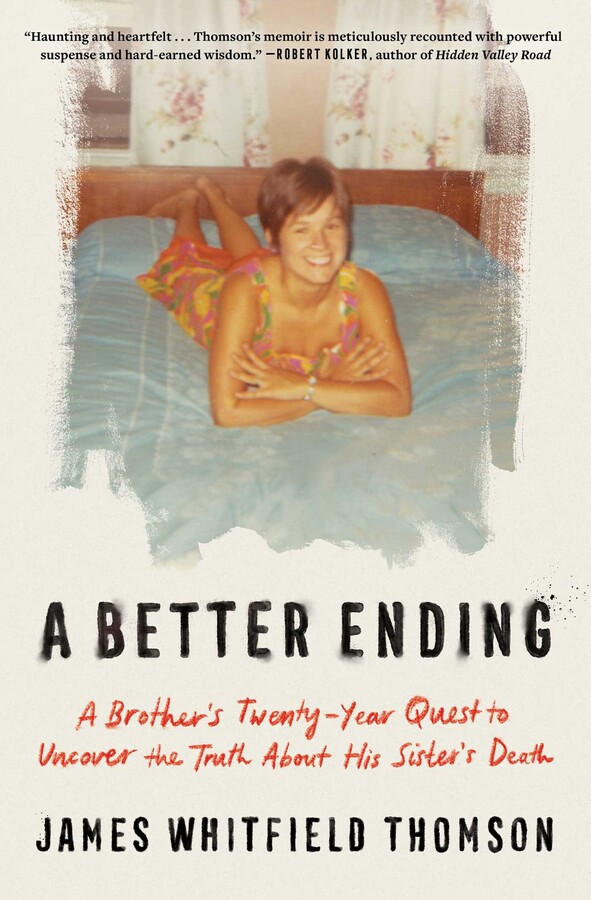
3. Consider the photo of Eileen on the book’s cover, how the author chose this particular image to represent his sister. The author has another photo of Eileen, taken at the same time. She is sitting on the bed holding a framed photo of Vic, who was overseas in the Air Force at the time. Discuss whether you think this would have been a better cover photo. Then, take a trip to a local museum or look through portrait photo archives online (the Library of Congress’s digital collections are an excellent source). Discuss what a photo can reveal and what it can hide. Imagine the stories behind each portrait you observe, then challenge yourself by asking why you made the assertions you did. Is a photo really worth a thousand words? Have fun!
An Interview with James Thomson
In your Author’s Note, you invite the reader into the investigation, welcome them to share their own opinion as they journey through the story with you. Why was it important to you to engage the reader in this way?
I think almost any book or essay sets up a dialogue between the author and the reader, so I wanted to make that point right up front. I have often said that writing a book, especially a memoir, is a very egotistical undertaking. Of all the things you could be doing in this wide, wonderful world, I’m asking you to spend eight or ten hours listening to me. This book is a journey, and I love the idea of feeling like the reader is going on that journey with me, discovering things as I discover them, sharing my heartache, my outrage, even an occasional laugh, though this story doesn’t exactly lend itself to humor.
Many poets have written poignantly about the deaths of loved ones, and you chose to quote Rainer Maria Rilke in the book’s epigraph. What about Rilke’s words felt most fitting as a gateway into A Better Ending?
I love reading poetry and Rilke in particular, though I can’t remember when I first read this poem. As I say in the first line of my book, I’ve had a lot of death in my life with my birth family all gone by the time I was 46, but what appealed to me about Rilke’s poem is the notion that there is one death in particular that keeps niggling at his consciousness. For me, that was particularly true of Eileen. Once I started the book the Rilke line that really stuck out for me is “Oh don’t take from me what I am slowly learning.” At one point I even thought about calling the memoir Slow Learner. It still baffles me why it took me so long to start down the road to find out more about her death.
Has your relationship with your memory of Eileen changed at all since you began writing this book?
Immensely, though in some ways she remains a mystery to me, and therefore a mystery to the reader. The few old friends of hers that I could find had nice things to say about how bright and energetic she was, but nothing deeper and certainly no dark premonitions. One of the things I was hoping to get out of the meeting with Vic was stories about Eileen, especially stories about happier times, but he had little to say other than that she was ambitious and had “plans.” So, I would say that it is not my memory of Eileen that has changed, but her constant presence in my life. I keep thinking of that Pink Floyd song, “Wish You Were Here.”
You have known multiple people who have taken their own lives, including your friend Kim and your childhood classmate Bruce Kinney. How have their stories given you insight into understanding Eileen’s situation?
Oh, boy, so many suicides. What I have come to believe is that each suicide has its own arc. Depression tops the list of reasons, of course, but millions of people have severe chronic depression and don’t resort to suicide. There are other reasons that get thrown into the mix—guilt, shame, fear, anger, extreme physical pain, hopelessness, maybe even revenge. What I do know is that some suicides can be impulsive. At a certain moment the person simply wishes he or she were dead. The easiest way to kill yourself impulsively is with a gun. It’s also the easiest way to commit a murder, which is why I would never have a gun in my house. As a coda, I find it fascinating that only 25-30% of people leave a suicide note, and most that do simply say they are sorry. It is we, the living, who long for an explanation.
Do you ever wish you had started your investigation into Eileen’s death sooner, or do you feel things ran their course in due time?
I wish I had dug deeper in the days and weeks after her death, but I was young and busy with my family and my schoolwork, so I simply filed it away under the rubric of “Bad Shit Happens.” Which now seems hopelessly immature and self-centered to me, and I spend a good part of the book beating myself up about that. Now I think I simply wasn’t ready for this journey until my kids were grown and off on their own.
When Keith was alive, you often felt angry with him, but when he died you felt mostly grief (and, you note, a surprising lack of anger). Why do you think your emotions changed? Could they have been affected by your previous experiences of loss?
My relationship with Keith was so complicated. It would be hard to exaggerate how much I looked up to him when I was a boy. Then he started doing things that were so repulsive and self-destructive that I didn’t want to be around him. I have heard people say, “Everything happens for a reason,” which is a rationalization I find difficult to accept. Does that mean that the Holocaust or the massacre of schoolchildren at Sandy Hook are all part of the God’s benign plan? I don’t think Keith’s stroke happened for a reason (other than the fact that he was a two-pack-a-day smoker), but I am grateful that his health problems gave us a chance to repair our relationship, and I could simply go back to loving him again. I don’t think the other losses in my life shaped how I felt about his death. It was just one more heartbreaking inevitability. I’ll be turning 80 later this year, and the losses continue to accumulate. We all have to deal with them, and I hope my book helps other people find strategies to cope with the losses of their own.
After you and Darryl meet with Vic and Laura, Elizabeth says to you, “this isn’t about forgiveness… It’s about acceptance.” How do you think acceptance changed the trajectory of this book and your life?
This entire book is about my journey to acceptance. Talk about self-indulgence! For a long time I couldn’t see how my obsession was hurting the people I loved, but they stuck by me, especially Elizabeth, who has a Ph.D. in acceptance. I'm in a much better place on the acceptance spectrum for having written this book, but I’d be a fool to think I have everything worked out. There will always be questions, misgivings, doubts. Somehow people like to believe there’s a rapid-fire movie of your entire life that flashes before your life just before you die. I’d like to think that what you get in that final moment is the answer.
While you use this text to look closely at Eileen’s life and death, you also allow yourself to focus on other family members (your parents, for example) in ways that you didn’t when they were alive. Did writing this book and investigating Eileen’s death help you feel closer to your parents?
Much, much closer to my whole family. It was one of the gifts the book gave me. I read every letter and every scrap of paper I could find, spent hours poring over old photographs. There is a sweetness in my father’s letters to me that belies the tyrannical bully I often felt him to be. It was fun going through all the things my mother had saved. Looking over her costume jewelry. Sniffing the bowls of my father’s pipes. I get a smile just thinking about my childhood and the times when we were all together. Writing was a way to bring that all back.
By the end of the book, Darryl and Cheri are practically like family to you. Have you stayed in touch with them or anyone else you met during the course of your investigation?
Darryl passed away about three years ago, but we remained close friends and would talk on the phone for hours. Elizabeth and I went to visit him twice at a home for aging veterans in Chula Vista, California. The book is dedicated to him and my children. Cheri and I are still close. Sometimes no contact for months then a flurry of email exchanges. I'm still friends with Bruce Edmands, the lawyer who was so helpful in the early stages of my investigation. Most of the other people I have lost touch with and many have passed away. But not Eileen’s best friend, Betty Clay, who is 99 and lives in a nursing home out west. She and I have had several wonderful reminiscences about Eileen.
A Better Ending is an incredibly vulnerable book. Were there any emotions that were particularly difficult to put on the page? If so, how did you overcome this discomfort?
I just looked up the phrase, Warts and all. It is said to come from Oliver Cromwell, Lord Protector of England, who wanted his portrait painted with all his blemishes revealed. I think that is the attitude one has to take in writing a memoir. In my Author’s Note at the beginning of the book, I say, “…readers are usually the best arbiters of truth. You will tell me if this is a story you believe.” I didn’t see how readers could possibly believe me if I didn’t allow myself to be open and vulnerable. It wasn’t always easy to reveal some things, like the fact that I once slapped my first wife or cheated on her with another woman, but I felt these were things that needed to be said. In her terrific book about grief, Sloane Crosley says that “real literature, like love, comes for the desire to be known.” The only way to really be known is not to lie to the reader, which, of course, begins with having the courage not to lie to yourself. The trick is to reveal unseemly events and raw emotions without indulging in self-flagellation or becoming too maudlin.
What advice would you offer to someone who is considering investigating and writing about a traumatic experience?
Dig in. Get started by keeping a journal; it doesn’t matter where you begin. If you allow yourself the freedom to write honestly about whatever comes to mind—facts, questions, doubts, anger, fears, grudges, prejudices, jealousies—you will find that certain themes and emotions keep coming up over and over again. Writing a book is a process. Grace Paley said, “We write about what we don’t know about what we know.” After a while you will begin to find out things that you’ve known all along but simply haven’t given yourself permission to say out loud or put down on paper. Much of it will never wind up in print, but you will amaze yourself with what you discover. Also, don’t rule out the help of professionals. This book wouldn’t never have gotten written without the help of Darryl, Cheri and numerous others who helped me along the way. Once you’ve gotten to a certain point, I strongly urge you to join a writers’ group and show your work to others. Their feedback, as long as you know your fellow writers are being honest, can be invaluable. Most of all, you need to understand that most good writing comes from rewriting.
About The Author
Christopher LaFarge
James W. Thomson grew up in Pittsburgh and attended Harvard College on a scholarship, after which he served as the navigator of a Navy ship off the coast of Vietnam, then earned a PhD in American studies. After a brief stint in academia, he had a successful career in business. His novel, Lies You Wanted to Hear, received wide acclaim. Jim and his wife live outside of Boston. They have five far-flung children and eleven grandchildren.
Product Details
- Publisher: Avid Reader Press/Simon & Schuster (March 25, 2025)
- Length: 304 pages
- ISBN13: 9781668062883
Raves and Reviews
“A haunting and heartfelt meditation on personal loss, James Thomson’s memoir is meticulously recounted with powerful suspense and hard-earned wisdom.” —Robert Kolker, #1 New York Times bestselling author of Hidden Valley Road
“An oh-so-compelling read for true crime fans, lovers of memoirs, and anyone who’s lost a sibling in unresolved ways. . . . See if you’re not left shaken.” —Terri Schlichenmeyer
“A Better Ending feels like reading the words of someone you know, a pal who has a remarkable story that somehow has never come up in conversation. His calm, questioning prose suits the story, which is surprisingly easy to relate to, despite its shocking elements: A brother wants to know more about his loved one’s death and, 50 years on, wonders if he could have done anything to prevent it. Those impulses feel deeply human.” —Minneapolis Star Tribune
“An ultimately provocative read . . . The book’s arguments about the nature of truth and the dread of uncertainty . . . give this memoir a depth lacking in many true-crime stories.” —Kirkus Reviews
“Gutting. A Better Ending is a heartbreaking work that examines how grief and tragedy ripple across decades. I cannot imagine the courage James Whitfield Thomson had to summon in order to face the brutality and ultimately the truth of his sister’s sudden death. His book does the seemingly impossible: for the briefest of moments, he brings her back to life.” —Rachel Louise Snyder, author of Women We Buried, Women We Burned and NBCC Finalist No Visible Bruises
“A brave and meticulous investigation of not only a death, but a life, A Better Ending reveals the destruction wrought by silence and asks whether we can ever truly know the people we love. Written with great feeling and structured like a mystery, this book is a beautiful monument to a lost sister and a lost time.” —Sarah Perry, author of After the Eclipse and Sweet Nothings
“Toggling artfully between past and present, Thomson’s account of his belated search for the truth of his younger sister’s death is both adrenaline-boosting whodunit and tender family memoir. But what impressed me most about A Better Ending was its author’s honesty as he followed the twists and turns wherever they led and learned along the way, not only about his sister’s death but also about himself.” —George Howe Colt, bestselling author of Brothers and The Big House
“James Thomson’s chronicle of his dogged search for answers that may or may not be findable lays bare a family’s evasions, intimacies, and impenetrable mysteries. A heartbreaking and mesmerizing book.” —Joan Wickersham, author of the National Book Award finalist The Suicide Index
“Murder or suicide? James Thomson seeks the truth of his sister's death in A Better Ending. His journey will take us across the country and across the decades, into the heart of darkness and out the other side. It's powerful and personal, a riveting true-crime page turner, destined to become a classic of the genre.” —William Martin, New York Times bestselling author of Back Bay and December '41
“James Thomson’s masterful and meticulous storytelling—part mystery, part elegy—is a gift for us all. This brave and unflinchingly honest book grabs you from the first page and does not let you go until the very last word.” —Meg Kissinger, author of While You Were Out
“Thomson weaves the mysteries surrounding his sister’s death with his own self-examination, taking a clear-eyed approach to his shortcomings. Reexamining the circumstances that led to her death won’t bring Eileen back, Thomson knows. But as he pursues a better ending, he revisits the sister he knew and reckons with his own guilt, anger, and memory.” —BookPage
“Compelling . . . A personal and highly readable account. . . . Was Eileen’s death a suicide or murder? A Better Ending answers that by descending into the unknowable.” —Pittsburgh Quarterly
Resources and Downloads
High Resolution Images
-
Book Cover Image (jpg): A Better Ending
eBook 9781668062883
-
Author Photo (jpg): James Whitfield Thomson Christopher LaFarge(0.1 MB)
Any use of an author photo must include its respective photo credit