Get our latest book recommendations, author news, and competitions right to your inbox.
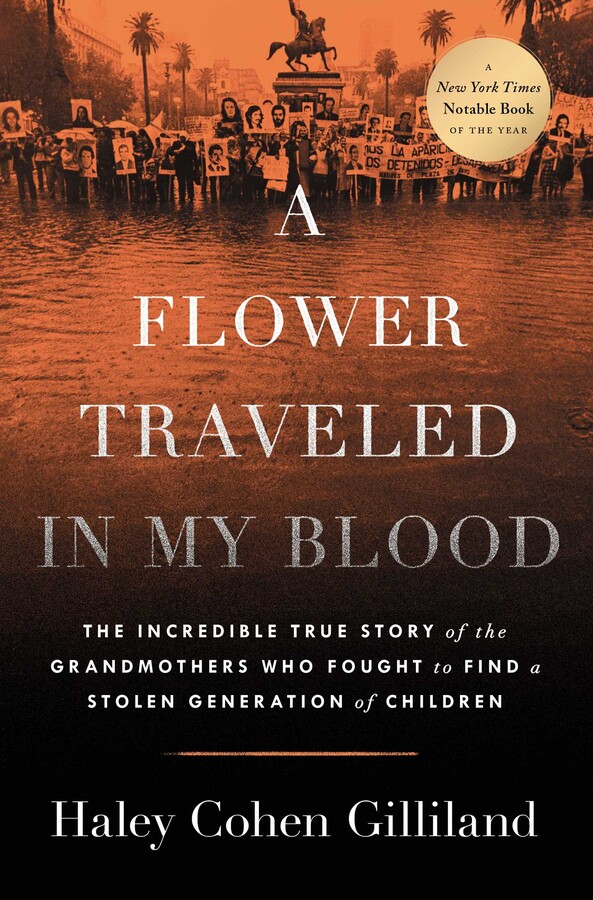
A Flower Traveled in My Blood
The Incredible True Story of the Grandmothers Who Fought to Find a Stolen Generation of Children
Table of Contents
About The Book
Finalist for the Pulitzer Prize in Nonfiction
NATIONAL BESTSELLER • A NEW YORK TIMES NOTABLE BOOK OF 2025 • THE WASHINGTON POST’S 5 BEST NONFICTION BOOKS OF 2025 • THE ATLANTIC’S 10 BEST BOOKS OF 2025 • THE NEW YORK PUBLIC LIBRARY'S BEST BOOKS OF 2025 • TIME MAGAZINE’S BEST BOOKS OF 2025 • NPR’S BEST BOOKS OF 2025
“[An] astonishing story…Powerful…Harrowing…Absorbing and lucid…You would have to harden your heart to be unmoved by the Abuelas’ quest.” —Jennifer Szalai, The New York Times Book Review (front-cover review)
“Inspiring…A triumphant saga of ordinary people doing extraordinary things in the face of pure malevolence.” —Hampton Sides • “Enthralling…Written with the nail-biting verve of a thriller.” —Publishers Weekly (starred review) • “Extraordinary...A harrowing and timely reminder of what happens when democracy succumbs to despotism.” —Adam Higginbotham • “[A] cinematically detailed, deeply researched narrative.” —The Washington Post • “Piercing, emotional...Will resonate for generations.” —Kirkus Reviews (starred review)
A remarkable new talent in narrative nonfiction delivers the epic true story of a group of courageous grandmothers who fought to find their grandchildren who were stolen.
In the early hours of March 24, 1976, the streets of Buenos Aires rumble with tanks as soldiers seize the presidential palace and topple Argentina’s leader. The country is now under the control of a military junta, with army chief Jorge Rafael Videla at the helm. With quiet support from the United States and tacit approval from much of Argentina’s people, who are tired of constant bombings and gunfights, the junta swiftly launches the National Reorganization Process or El Proceso—a bland name masking their ruthless campaign to crush the political left and instill the country with “Western, Christian” values. The junta holds power until 1983 and decimates a generation.
One of the military’s most diabolical acts is kidnapping hundreds of pregnant women. After giving birth in captivity, the women are “disappeared,” and their babies secretly given to other families—many of them headed by police or military officers. For mothers of pregnant daughters and daughters-in-law, the source of their grief is twofold—the disappearances of their children, and the theft of their grandchildren. A group of fierce grandmothers forms the Abuelas de Plaza de Mayo, dedicated to finding the stolen infants and seeking justice from a nation that betrayed them. At a time when speaking out could mean death, the Abuelas confront military officers and launch protests to reach international diplomats and journalists. They become detectives, adopting disguises to observe suspected grandchildren, and even work alongside a renowned American scientist to pioneer groundbreaking genetic tests.
A Flower Traveled in My Blood is the rarest of nonfiction that reads like a novel and puts your heart in your throat. It is the product of years of extensive archival research and meticulous, original reporting. It marks the arrival of a blazing new talent in narrative journalism. In these pages, a regime tries to terrorize a country, but love prevails. The grandmothers’ stunning stories reveal new truths about memory, identity, and family.
NATIONAL BESTSELLER • A NEW YORK TIMES NOTABLE BOOK OF 2025 • THE WASHINGTON POST’S 5 BEST NONFICTION BOOKS OF 2025 • THE ATLANTIC’S 10 BEST BOOKS OF 2025 • THE NEW YORK PUBLIC LIBRARY'S BEST BOOKS OF 2025 • TIME MAGAZINE’S BEST BOOKS OF 2025 • NPR’S BEST BOOKS OF 2025
“[An] astonishing story…Powerful…Harrowing…Absorbing and lucid…You would have to harden your heart to be unmoved by the Abuelas’ quest.” —Jennifer Szalai, The New York Times Book Review (front-cover review)
“Inspiring…A triumphant saga of ordinary people doing extraordinary things in the face of pure malevolence.” —Hampton Sides • “Enthralling…Written with the nail-biting verve of a thriller.” —Publishers Weekly (starred review) • “Extraordinary...A harrowing and timely reminder of what happens when democracy succumbs to despotism.” —Adam Higginbotham • “[A] cinematically detailed, deeply researched narrative.” —The Washington Post • “Piercing, emotional...Will resonate for generations.” —Kirkus Reviews (starred review)
A remarkable new talent in narrative nonfiction delivers the epic true story of a group of courageous grandmothers who fought to find their grandchildren who were stolen.
In the early hours of March 24, 1976, the streets of Buenos Aires rumble with tanks as soldiers seize the presidential palace and topple Argentina’s leader. The country is now under the control of a military junta, with army chief Jorge Rafael Videla at the helm. With quiet support from the United States and tacit approval from much of Argentina’s people, who are tired of constant bombings and gunfights, the junta swiftly launches the National Reorganization Process or El Proceso—a bland name masking their ruthless campaign to crush the political left and instill the country with “Western, Christian” values. The junta holds power until 1983 and decimates a generation.
One of the military’s most diabolical acts is kidnapping hundreds of pregnant women. After giving birth in captivity, the women are “disappeared,” and their babies secretly given to other families—many of them headed by police or military officers. For mothers of pregnant daughters and daughters-in-law, the source of their grief is twofold—the disappearances of their children, and the theft of their grandchildren. A group of fierce grandmothers forms the Abuelas de Plaza de Mayo, dedicated to finding the stolen infants and seeking justice from a nation that betrayed them. At a time when speaking out could mean death, the Abuelas confront military officers and launch protests to reach international diplomats and journalists. They become detectives, adopting disguises to observe suspected grandchildren, and even work alongside a renowned American scientist to pioneer groundbreaking genetic tests.
A Flower Traveled in My Blood is the rarest of nonfiction that reads like a novel and puts your heart in your throat. It is the product of years of extensive archival research and meticulous, original reporting. It marks the arrival of a blazing new talent in narrative journalism. In these pages, a regime tries to terrorize a country, but love prevails. The grandmothers’ stunning stories reveal new truths about memory, identity, and family.
Reading Group Guide
Join our mailing list! Get our latest book recommendations, author news, and competitions right to your inbox.
By clicking 'Sign me up' I acknowledge that I have read and agree to the privacy policy and terms of use, and the transfer of my personal data to the United States, where the privacy laws may be different than those in my country of residence.
Reading Group Guide
A Flower Traveled in My Blood
Haley Cohen Gilliland
This reading group guide for A Flower Traveled in My Blood includes an introduction, discussion questions, ideas for enhancing your book club, and a Q&A with author Haley Cohen Gilliland. The suggested questions are intended to help your reading group find new and interesting angles and topics for your discussion. We hope that these ideas will enrich your conversation and increase your enjoyment of the book.
Introduction
In the early hours of March 24, 1976, the streets of Buenos Aires rumble with tanks as soldiers seize the presidential palace and topple Argentina’s leader. The country is now under the control of a military junta, with army chief Jorge Rafael Videla at the helm. The junta swiftly launches a ruthless campaign to crush the political left and instill the country with “Western, Christian” values. One of the military’s most diabolical acts is kidnapping hundreds of pregnant women. After giving birth in captivity, the women are “disappeared” and their babies secretly given to other families—many of them headed by police or military officers.
For mothers of pregnant daughters and daughters-in-law, the source of their grief is twofold—the disappearances of their children, and the theft of their grandchildren. A group of fierce grandmothers forms the Abuelas de Plaza de Mayo, dedicated to finding the stolen infants and seeking justice from a nation that betrayed them. The grandmothers’ stunning stories reveal new truths about memory, identity, and family.
Topics & Questions for Discussion
1. A Flower Traveled in My Blood is a line from Juan Gelman’s poem titled “Epitaph.” Author Haley Cohen Gilliland chose to title the book after this poem even though it was written long before 1976. Why do you think “Epitaph” was chosen? How does this poem serve as a frame for the story that follows?
2. How does the history provided in Part One help contextualize what led to Jorge Rafael Videla’s rise to power? What does this timeline suggest about the conditions that lead to dictatorship and state-sanctioned violence?
3. How does the combination of historical accounts and personal narratives make this book unique—not only journalism nor history, but both? How would your reading be different if the book didn’t include the stories of women like Rosa?
4. This book portrays the Abuelas as simultaneously strong and emotionally affected. Alongside one another, women could feel their grief and get support from others who understood their pain. In what ways were their emotions the driving force for the organization’s efforts? How did these emotions both inspire action and affect connection/community?
5. What role did the news and media play in the Abuelas’ fight for justice? How did these women use it to their advantage? How did their ideological opponents use the media against the Abuelas, and how did they respond?
6. What role did the Argentine Church and other religious organizations play in the search for the missing grandchildren?
7. When the stolen grandchildren reconnected with their biological families, their reunions weren’t always smooth. What are the different factors that made reunion so complicated?
8. Following the end of the dictatorship, the country grappled with how to recover from the brutalities of the past. They asked: is it best to push forward and forget or to directly confront past harm? Discuss how efforts on each side of this debate affected the Abuelas and the public at large.
9. How much of this history were you aware of prior to reading this book? How does this new knowledge inform your perspective as a civilian and political subject? Do you find yourself personally inspired or empowered by the strength of the Abuelas?
10. Various locations from this period, such as the ESMA, have been preserved or turned into historical sites. Are these places you would be interested in visiting and why or why not? What emotions does this idea stir up inside of you?
11. If you had to pick someone from this book to interview, who would it be and why? What questions would you ask them?
12. The Abuelas de la Plaza de Mayo are still fighting to this day to find all of the missing grandchildren and give them the chance to know their real identities. What about their organization has helped them achieve such longevity? What are their strengths and what makes them so powerful in public consciousness?
Enhance Your Book Club
1. In response to losing her parents and brother, Rosa’s granddaughter Mariana wrote poems about her grief and hope. Write your own poems in response to how this story made you feel, or to your own experience of loss.
2. Write a letter to one of the Abuelas featured in the book. What in particular did you connect with most about her story? What was inspiring or meaningful to you?
3. Make a list of other works of nonfiction you might read that are a testament to the power of love and grief in the fight against tyranny and violence.
A Conversation with Haley Cohen Gilliland
Who was the first Abuela that you interviewed for this book? What was it like meeting an Abuela for the first time?
The first Abuela I interviewed for A Flower Traveled in My Blood was Rosa Roisinblit, one of the book’s central subjects. We met in her cozy apartment near Argentina’s Congressional Palace, where she had lived for decades—having moved there shortly before her daughter, Patricia, disappeared in 1978. Though more than forty years had passed since Patricia’s abduction, she was still very present in the apartment; everywhere I looked, photos of Patricia smiled back.
Rosa was one hundred and two at the time of our conversation, but age had not diminished her unvarnished wit. At one point, she slipped a photo of several Abuelas across her dining room table, pointed at one, and said: “She wears glasses because glasses make her look pretty, and that’s it,” implying that the grandmother did not need the bifocals to see. She added: “If there’s anything you want to know, anything you want to ask me, just ask. And I’ll tell you the truth—I like telling the truth. If I’m going to say something, I’d rather tell the truth.”
That conversation with Rosa set the tone for the project. I felt not only liberated to tell the stories in the book in their full, truthful complexity, but encouraged to do so.
How was writing this book different from writing a typical feature story, other than the obvious difference in length? Did you find weaving together so many narratives and historical facts challenging?
I knew from the beginning the Abuelas’ story needed to be a book. There were so many rich intertwining narratives that begged to be told—narratives that would not have made the cut in even a lengthy magazine feature. In particular, I felt the Abuelas’ extraordinary scientific work had not received the depth of treatment it deserved, and I was eager to rectify that.
I interviewed scores of Abuelas, grandchildren, diplomats, historians, and scientists; read hundreds of books and thousands of court documents; and reviewed tens of thousands of archival documents to write this book. Condensing all that information into a taut story was the greatest challenge.
The first part of writing this book was more like painting. I wrote without editing myself too much, layering on detail after detail until I felt I had a full, textured canvas. The second part of the process was more akin to sculpting. I had a writing professor in college named Anne Fadiman, who happens to be one of the most stunning narrative nonfiction writers on the planet. Great writing, she teaches her classes, requires excision. “How did Michelangelo carve The David?” she would ask us. “He took a piece of marble and chipped away all the pieces that didn’t look like David.” Or as Michelangelo himself put it, “The more the marble wastes, the more the statue grows.”
Seeing carefully crafted sentences succumb to the delete button was painful. But, in the end, I believe whittling the book down to its core essence made it more compelling.
What was it like to investigate the scientific methods used by Abuelas and their supporters to try and prove heredity between grandparents and grandchildren? What kind of familiarity did you have with genetics before you started writing this book?
Science was not my strongest academic area in school; My high school biology teacher would probably cackle to learn I wrote a book so heavily focused on genetics. But as a journalist, I have long been drawn toward scientists and scientific advances. I enjoy writing about people who are obsessed with something—an idea, a sport, a desire to change, or a drive to make change. Obsessive people tend to make the most interesting subjects, and scientists almost always fit this description. While scientific breakthroughs are thrilling, the day-to-day work required to reach those breakthroughs is often rote. It requires extreme persistence, and yes, obsession.
In my magazine work, I have written about dipterists (scientists who study flies) for National Geographic and a cell biologist attempting to make lab-grown breastmilk for MIT Technology Review. Genetics played a major role in a piece I wrote about one Argentine polo player’s quest to clone his top horses for Vanity Fair.
These experiences ignited my love of science writing and helped me shed my fear of seeming like a fool. When I didn’t understand something—which happened a lot!—I wasn’t afraid to ask silly questions, even of brilliant scientists like Mary-Claire King. My hope is that, as a result, the science in the book will be accessible and exciting to readers, even those of us who didn’t exactly ace our pop quizzes on Gregor Mendel.
Did you personally visit the ESMA or any other historical sites that you wrote about? If so, how did that inform your writing? If not, would you consider going?
I tried to visit as many of the sites described in my book as possible. When attempting to immerse a reader in a place, to make them feel as though they are there with the subjects, there is no replacement for experiencing it yourself—noticing how your footsteps echo on the cold floor, feeling the rough texture of the walls, smelling the dank air.
I spent hours at the ESMA museum, where the clandestine detention center once functioned. On one of my visits, I stood silently in the room where Patricia Roisinblit was held during her pregnancy, letting the nausea and claustrophobia wash over me. It was dark, and hot, and the air was stale from lack of ventilation. The slant of the ceiling made it hard to walk far without smacking my forehead. I happened to be four months pregnant at the time, and I was overcome by how truly horrific it must have been to experience the final days of pregnancy imprisoned in that stifling, grimy room, gripped by fear of the future.
You have said that this subject came back to you after being dormant for many years in 2020 while you were pregnant. Do you think it was the personal experience of pregnancy and motherhood that brought the topic back to you? What were challenges you faced in confronting this brutal history while being a mother yourself?
The Abuelas’ story has lived in my head and heart since I first learned it. But the four years I worked in Argentina lulled me into the erroneous belief that their story was already universally known. Years later, a conversation with several fellow history enthusiasts punctured that assumption. They never heard of the Abuelas, and had no clue what they’d accomplished.
At that time, I happened to be pregnant with my first child and my head often echoed with fears about my daughter’s safety—did unpasteurized cheese sneak into my salad? Did my dog’s sudden decision to perform a tap dance on my belly hurt her? Even before she was born, I was terrified of something happening to her.
The Abuelas’ story has always moved me deeply, and I don’t think you need to be a parent to understand the horror of what they endured or to admire their courageous response. But being pregnant—and then becoming a mother—made my reaction to their story even more visceral.
The history of the Abuelas is incredibly layered, with its fair share of triumphs and setbacks. Which of their successes left you most awestruck? Were there any events in this story that seem particularly miraculous?
Most of the Abuelas did not have scientific backgrounds or much professional experience. If they worked outside the home, they did so largely as schoolteachers, and many had given up their careers to raise their children. They didn’t have consistent sources of funding. During the dictatorship, their work could have easily gotten them killed by the military government; since the return of democracy, government support has been erratic at best. But together, powered by sheer love of family, the women have found 139 of their stolen grandchildren, pioneered new forms of genetic testing, and shaped international law.
You have mentioned that your research for this book included scouring archives and reading lengthy legal documents. How difficult was it to get through all of the archives and documents in order to find the information that you needed? Are there any other research methods you employed?
To write a propulsive narrative history requires immersing readers in a time and place—helping them see, smell, and hear the events being described. Doing that requires collecting vast amounts of detail. The Abuelas I interviewed ranged from eighty-seven to one hundred and two. Asking anyone to remember small details from forty years ago—let alone asking someone in their second century to do so—is unrealistic and unfair. I quickly understood that archival research would be crucial in helping to tell the Abuelas’ story.
When I first began my reporting, I worried there wouldn’t be enough archival material to work with. The dictatorship destroyed most documents related to its disappearances before leaving power, and I didn’t know what other documentary sources had survived. Thankfully, my fears were misplaced. I learned the Argentine government has an incredible trove of documents available for consultation at the Archivo Nacional de La Memoria and that other groups like Memoria Abierta had collected extensive oral histories and photographic archives. A few years before I began writing this book, the U.S. declassified huge tranches of government cables related to Argentina’s dictatorship and while I was reporting, Rosa Roisinblit’s personal archive was donated and made available for consultation.
I was also thrilled to learn that the Abuelas themselves had kept careful records. Those making history are not always aware they’re doing so—they may not save their correspondence, take photographs, or record their activities in writing. Despite the clear dangers, the Abuelas had the prescience and courage to document their work, pasting snapshots into black three-ring binders, and filling boxes up with correspondence and scientific reports. Gathering such information was a subversive act in and of itself—one that easily could have gotten the Abuelas disappeared. But they understood the importance of doing so, and their institutional archive now fills thousands of boxes that were incredibly helpful to me in retelling their story.
In “About This Book” you described how difficult it was for you to narrow your scope to only a few individuals, as there were so many affected. However, you found that “trying to tell the stories of all of the Abuelas’ stolen grandchildren would mean not doing justice to any of them” (page 337). Can you tell us about one of the stories that you were unable to fit into this book?
I would have loved more space to explore Victoria Donda’s experience. In many ways, it mirrors the awful stories of many of the Abuelas’ stolen grandchildren: Victoria’s mother was abducted by the dictatorship while five months pregnant and eventually brought to the ESMA to give birth. Her father was later taken as well. But Victoria’s story had one unbelievable twist: her uncle—her father’s brother, Adolfo—was a naval officer at the ESMA. In 2023, Adolfo was put on trial, where witnesses insisted that he knew about the disappearances of his brother and sister-in-law. His fierce commitment to the dictatorship’s ideology seemed to outweigh his loyalty to his own kin. The following year, in 2024, Adolfo was convicted for Victoria’s kidnapping. “I still don’t know where my parents are,” she wrote after the ruling. “But I know that today, they are resting in peace.”
What do you hope readers take away from A Flower Traveled in My Blood?
I majored in history in college. Many of my friends studied history. And yet when I told them the Abuelas’ story, they gaped at me in disbelief. Journalists write so people know what happened. Historians write so people remember it. I wrote this book for both reasons.
There is no avoiding the darkness in these pages, but I hope that when readers close the back cover, they feel inspired. The Abuelas’ story proves that, with persistence, ordinary people can make extraordinary change, and that fear is no match for love.
A Flower Traveled in My Blood
Haley Cohen Gilliland
This reading group guide for A Flower Traveled in My Blood includes an introduction, discussion questions, ideas for enhancing your book club, and a Q&A with author Haley Cohen Gilliland. The suggested questions are intended to help your reading group find new and interesting angles and topics for your discussion. We hope that these ideas will enrich your conversation and increase your enjoyment of the book.
Introduction
In the early hours of March 24, 1976, the streets of Buenos Aires rumble with tanks as soldiers seize the presidential palace and topple Argentina’s leader. The country is now under the control of a military junta, with army chief Jorge Rafael Videla at the helm. The junta swiftly launches a ruthless campaign to crush the political left and instill the country with “Western, Christian” values. One of the military’s most diabolical acts is kidnapping hundreds of pregnant women. After giving birth in captivity, the women are “disappeared” and their babies secretly given to other families—many of them headed by police or military officers.
For mothers of pregnant daughters and daughters-in-law, the source of their grief is twofold—the disappearances of their children, and the theft of their grandchildren. A group of fierce grandmothers forms the Abuelas de Plaza de Mayo, dedicated to finding the stolen infants and seeking justice from a nation that betrayed them. The grandmothers’ stunning stories reveal new truths about memory, identity, and family.
Topics & Questions for Discussion
1. A Flower Traveled in My Blood is a line from Juan Gelman’s poem titled “Epitaph.” Author Haley Cohen Gilliland chose to title the book after this poem even though it was written long before 1976. Why do you think “Epitaph” was chosen? How does this poem serve as a frame for the story that follows?
2. How does the history provided in Part One help contextualize what led to Jorge Rafael Videla’s rise to power? What does this timeline suggest about the conditions that lead to dictatorship and state-sanctioned violence?
3. How does the combination of historical accounts and personal narratives make this book unique—not only journalism nor history, but both? How would your reading be different if the book didn’t include the stories of women like Rosa?
4. This book portrays the Abuelas as simultaneously strong and emotionally affected. Alongside one another, women could feel their grief and get support from others who understood their pain. In what ways were their emotions the driving force for the organization’s efforts? How did these emotions both inspire action and affect connection/community?
5. What role did the news and media play in the Abuelas’ fight for justice? How did these women use it to their advantage? How did their ideological opponents use the media against the Abuelas, and how did they respond?
6. What role did the Argentine Church and other religious organizations play in the search for the missing grandchildren?
7. When the stolen grandchildren reconnected with their biological families, their reunions weren’t always smooth. What are the different factors that made reunion so complicated?
8. Following the end of the dictatorship, the country grappled with how to recover from the brutalities of the past. They asked: is it best to push forward and forget or to directly confront past harm? Discuss how efforts on each side of this debate affected the Abuelas and the public at large.
9. How much of this history were you aware of prior to reading this book? How does this new knowledge inform your perspective as a civilian and political subject? Do you find yourself personally inspired or empowered by the strength of the Abuelas?
10. Various locations from this period, such as the ESMA, have been preserved or turned into historical sites. Are these places you would be interested in visiting and why or why not? What emotions does this idea stir up inside of you?
11. If you had to pick someone from this book to interview, who would it be and why? What questions would you ask them?
12. The Abuelas de la Plaza de Mayo are still fighting to this day to find all of the missing grandchildren and give them the chance to know their real identities. What about their organization has helped them achieve such longevity? What are their strengths and what makes them so powerful in public consciousness?
Enhance Your Book Club
1. In response to losing her parents and brother, Rosa’s granddaughter Mariana wrote poems about her grief and hope. Write your own poems in response to how this story made you feel, or to your own experience of loss.
2. Write a letter to one of the Abuelas featured in the book. What in particular did you connect with most about her story? What was inspiring or meaningful to you?
3. Make a list of other works of nonfiction you might read that are a testament to the power of love and grief in the fight against tyranny and violence.
A Conversation with Haley Cohen Gilliland
Who was the first Abuela that you interviewed for this book? What was it like meeting an Abuela for the first time?
The first Abuela I interviewed for A Flower Traveled in My Blood was Rosa Roisinblit, one of the book’s central subjects. We met in her cozy apartment near Argentina’s Congressional Palace, where she had lived for decades—having moved there shortly before her daughter, Patricia, disappeared in 1978. Though more than forty years had passed since Patricia’s abduction, she was still very present in the apartment; everywhere I looked, photos of Patricia smiled back.
Rosa was one hundred and two at the time of our conversation, but age had not diminished her unvarnished wit. At one point, she slipped a photo of several Abuelas across her dining room table, pointed at one, and said: “She wears glasses because glasses make her look pretty, and that’s it,” implying that the grandmother did not need the bifocals to see. She added: “If there’s anything you want to know, anything you want to ask me, just ask. And I’ll tell you the truth—I like telling the truth. If I’m going to say something, I’d rather tell the truth.”
That conversation with Rosa set the tone for the project. I felt not only liberated to tell the stories in the book in their full, truthful complexity, but encouraged to do so.
How was writing this book different from writing a typical feature story, other than the obvious difference in length? Did you find weaving together so many narratives and historical facts challenging?
I knew from the beginning the Abuelas’ story needed to be a book. There were so many rich intertwining narratives that begged to be told—narratives that would not have made the cut in even a lengthy magazine feature. In particular, I felt the Abuelas’ extraordinary scientific work had not received the depth of treatment it deserved, and I was eager to rectify that.
I interviewed scores of Abuelas, grandchildren, diplomats, historians, and scientists; read hundreds of books and thousands of court documents; and reviewed tens of thousands of archival documents to write this book. Condensing all that information into a taut story was the greatest challenge.
The first part of writing this book was more like painting. I wrote without editing myself too much, layering on detail after detail until I felt I had a full, textured canvas. The second part of the process was more akin to sculpting. I had a writing professor in college named Anne Fadiman, who happens to be one of the most stunning narrative nonfiction writers on the planet. Great writing, she teaches her classes, requires excision. “How did Michelangelo carve The David?” she would ask us. “He took a piece of marble and chipped away all the pieces that didn’t look like David.” Or as Michelangelo himself put it, “The more the marble wastes, the more the statue grows.”
Seeing carefully crafted sentences succumb to the delete button was painful. But, in the end, I believe whittling the book down to its core essence made it more compelling.
What was it like to investigate the scientific methods used by Abuelas and their supporters to try and prove heredity between grandparents and grandchildren? What kind of familiarity did you have with genetics before you started writing this book?
Science was not my strongest academic area in school; My high school biology teacher would probably cackle to learn I wrote a book so heavily focused on genetics. But as a journalist, I have long been drawn toward scientists and scientific advances. I enjoy writing about people who are obsessed with something—an idea, a sport, a desire to change, or a drive to make change. Obsessive people tend to make the most interesting subjects, and scientists almost always fit this description. While scientific breakthroughs are thrilling, the day-to-day work required to reach those breakthroughs is often rote. It requires extreme persistence, and yes, obsession.
In my magazine work, I have written about dipterists (scientists who study flies) for National Geographic and a cell biologist attempting to make lab-grown breastmilk for MIT Technology Review. Genetics played a major role in a piece I wrote about one Argentine polo player’s quest to clone his top horses for Vanity Fair.
These experiences ignited my love of science writing and helped me shed my fear of seeming like a fool. When I didn’t understand something—which happened a lot!—I wasn’t afraid to ask silly questions, even of brilliant scientists like Mary-Claire King. My hope is that, as a result, the science in the book will be accessible and exciting to readers, even those of us who didn’t exactly ace our pop quizzes on Gregor Mendel.
Did you personally visit the ESMA or any other historical sites that you wrote about? If so, how did that inform your writing? If not, would you consider going?
I tried to visit as many of the sites described in my book as possible. When attempting to immerse a reader in a place, to make them feel as though they are there with the subjects, there is no replacement for experiencing it yourself—noticing how your footsteps echo on the cold floor, feeling the rough texture of the walls, smelling the dank air.
I spent hours at the ESMA museum, where the clandestine detention center once functioned. On one of my visits, I stood silently in the room where Patricia Roisinblit was held during her pregnancy, letting the nausea and claustrophobia wash over me. It was dark, and hot, and the air was stale from lack of ventilation. The slant of the ceiling made it hard to walk far without smacking my forehead. I happened to be four months pregnant at the time, and I was overcome by how truly horrific it must have been to experience the final days of pregnancy imprisoned in that stifling, grimy room, gripped by fear of the future.
You have said that this subject came back to you after being dormant for many years in 2020 while you were pregnant. Do you think it was the personal experience of pregnancy and motherhood that brought the topic back to you? What were challenges you faced in confronting this brutal history while being a mother yourself?
The Abuelas’ story has lived in my head and heart since I first learned it. But the four years I worked in Argentina lulled me into the erroneous belief that their story was already universally known. Years later, a conversation with several fellow history enthusiasts punctured that assumption. They never heard of the Abuelas, and had no clue what they’d accomplished.
At that time, I happened to be pregnant with my first child and my head often echoed with fears about my daughter’s safety—did unpasteurized cheese sneak into my salad? Did my dog’s sudden decision to perform a tap dance on my belly hurt her? Even before she was born, I was terrified of something happening to her.
The Abuelas’ story has always moved me deeply, and I don’t think you need to be a parent to understand the horror of what they endured or to admire their courageous response. But being pregnant—and then becoming a mother—made my reaction to their story even more visceral.
The history of the Abuelas is incredibly layered, with its fair share of triumphs and setbacks. Which of their successes left you most awestruck? Were there any events in this story that seem particularly miraculous?
Most of the Abuelas did not have scientific backgrounds or much professional experience. If they worked outside the home, they did so largely as schoolteachers, and many had given up their careers to raise their children. They didn’t have consistent sources of funding. During the dictatorship, their work could have easily gotten them killed by the military government; since the return of democracy, government support has been erratic at best. But together, powered by sheer love of family, the women have found 139 of their stolen grandchildren, pioneered new forms of genetic testing, and shaped international law.
You have mentioned that your research for this book included scouring archives and reading lengthy legal documents. How difficult was it to get through all of the archives and documents in order to find the information that you needed? Are there any other research methods you employed?
To write a propulsive narrative history requires immersing readers in a time and place—helping them see, smell, and hear the events being described. Doing that requires collecting vast amounts of detail. The Abuelas I interviewed ranged from eighty-seven to one hundred and two. Asking anyone to remember small details from forty years ago—let alone asking someone in their second century to do so—is unrealistic and unfair. I quickly understood that archival research would be crucial in helping to tell the Abuelas’ story.
When I first began my reporting, I worried there wouldn’t be enough archival material to work with. The dictatorship destroyed most documents related to its disappearances before leaving power, and I didn’t know what other documentary sources had survived. Thankfully, my fears were misplaced. I learned the Argentine government has an incredible trove of documents available for consultation at the Archivo Nacional de La Memoria and that other groups like Memoria Abierta had collected extensive oral histories and photographic archives. A few years before I began writing this book, the U.S. declassified huge tranches of government cables related to Argentina’s dictatorship and while I was reporting, Rosa Roisinblit’s personal archive was donated and made available for consultation.
I was also thrilled to learn that the Abuelas themselves had kept careful records. Those making history are not always aware they’re doing so—they may not save their correspondence, take photographs, or record their activities in writing. Despite the clear dangers, the Abuelas had the prescience and courage to document their work, pasting snapshots into black three-ring binders, and filling boxes up with correspondence and scientific reports. Gathering such information was a subversive act in and of itself—one that easily could have gotten the Abuelas disappeared. But they understood the importance of doing so, and their institutional archive now fills thousands of boxes that were incredibly helpful to me in retelling their story.
In “About This Book” you described how difficult it was for you to narrow your scope to only a few individuals, as there were so many affected. However, you found that “trying to tell the stories of all of the Abuelas’ stolen grandchildren would mean not doing justice to any of them” (page 337). Can you tell us about one of the stories that you were unable to fit into this book?
I would have loved more space to explore Victoria Donda’s experience. In many ways, it mirrors the awful stories of many of the Abuelas’ stolen grandchildren: Victoria’s mother was abducted by the dictatorship while five months pregnant and eventually brought to the ESMA to give birth. Her father was later taken as well. But Victoria’s story had one unbelievable twist: her uncle—her father’s brother, Adolfo—was a naval officer at the ESMA. In 2023, Adolfo was put on trial, where witnesses insisted that he knew about the disappearances of his brother and sister-in-law. His fierce commitment to the dictatorship’s ideology seemed to outweigh his loyalty to his own kin. The following year, in 2024, Adolfo was convicted for Victoria’s kidnapping. “I still don’t know where my parents are,” she wrote after the ruling. “But I know that today, they are resting in peace.”
What do you hope readers take away from A Flower Traveled in My Blood?
I majored in history in college. Many of my friends studied history. And yet when I told them the Abuelas’ story, they gaped at me in disbelief. Journalists write so people know what happened. Historians write so people remember it. I wrote this book for both reasons.
There is no avoiding the darkness in these pages, but I hope that when readers close the back cover, they feel inspired. The Abuelas’ story proves that, with persistence, ordinary people can make extraordinary change, and that fear is no match for love.
About The Author
(c) Rachael Gorrie
Haley Cohen Gilliland is a journalist and the director of the Yale Journalism Initiative. She previously worked at The Economist for seven years, four of which were spent in Buenos Aires as the paper’s Argentina correspondent. Following her time at The Economist, she has focused on narrative nonfiction—bringing history and current events to life through fact-based storytelling. She has published long-form feature articles in The New York Times, National Geographic, Bloomberg Businessweek, and Vanity Fair, among other publications. She lives in New York state with her husband, two children, and dogs. A Flower Traveled in My Blood is her first book.
Product Details
- Publisher: Avid Reader Press/Simon & Schuster (July 15, 2025)
- Length: 512 pages
- ISBN13: 9781668017166
Raves and Reviews
The New York Times 100 Notable Books of 2025
The Washington Post Top 5 Nonfiction Books of 2025
The Atlantic Best 10 Books of 2025
New York Public Library Best Books of 2025
The New Yorker Best Books of the Year So Far
TIME 100 Must-Read Books of 2025
BookPage Best 10 Books of 2025
Kirkus Reviews Best Nonfiction Books of the Year
“[An] astonishing story . . . Powerful . . . Harrowing . . . Absorbing and lucid . . . You would have to harden your heart to be unmoved by the Abuelas’ quest.” —Jennifer Szalai, The New York Times Book Review (front-cover review)
“An enthralling history of a human rights movement whose mission remains as urgent as ever . . . A Flower Traveled in My Blood reads like a Cold War thriller. . . . Gilliland interrogates what it means to pursue—and ultimately find—justice for the victims of these crimes against humanity.” —The Nation
“Immaculately researched and endlessly readable, this unforgettable debut is a testament to ruthless and unchecked far-right military control and the power of collective strength, courage, and protest to overcome it.” —Ms. Magazine
“A Flower Traveled in My Blood is an unflinching playbook of what happens when a government’s tyrannical impulses are fed as well as a heartbreaking, immersive account of what it means to stand up against injustice and demand that those who allow it move out of the way.” —Booklist (starred review)
“[A] deeply researched and cinematically told work of history.” —The Washington Post
“Gilliland’s first book (of many, we should hope) tells the remarkable story of the Abuelas de Plaza de Mayo. . . . Grandmothers came together across social divides to fight for their families, sometimes discovering reserves of strength they didn't know they had. The Abuelas remain united in their struggle to this day and Gillibrand does a masterful job conveying their extraordinary story.” —NPR
“This well-crafted, emotionally rich work of narrative nonfiction presents a cautionary tale—suddenly starkly relevant to our times—of the horrors that can transpire when a government callously labels its political opponents ‘subversives’ and ‘terrorists’ and empowers law enforcement with unrestricted authorities.” —Foreign Affairs
“No book that I read last year integrates its intellectual and human elements better, to my mind, than A Flower Traveled in My Blood, Haley Cohen Gilliland’s account of the relentless grandmothers of the young people kidnapped and disappeared by Argentina’s government during the 1970s. I’ve been telling people that you could easily make three different, equally excellent movies out of her book . . . and that none of them would capture its best parts.” —Boris Kachka, The Atlantic
“[Gilliland] conveys the complicated, heart-wrenching fullness of her characters’ individual stories and shades their backdrop with compulsively readable history of geopolitical tension and the emerging DNA science that fueled the Abuelas’ fight. Gilliland’s work, exhaustively and compassionately researched, offers a crucial counterbalance to the dark legacy of Argentina’s desaparecidos, injecting the light of a model resistance movement that lay the groundwork for future international human rights investigations. Her humility and respect for the fraught journeys her subjects made toward each other and for the vital questions their journeys raised—about power, identity, family, and collective memory and healing—ensure the text will resonate for generations the world over. A piercing, emotional tribute to the value of persistent resistance.” —Kirkus Reviews (starred review)
“Enthralling . . . Written with the nail-biting verve of a thriller, this spotlights relentless perseverance in the face of unthinkable brutality.” —Publishers Weekly (starred review)
“Deeply reported . . . Gilliland focuses on the ordeal of a single shattered family, widens her lens to include other cases, and embeds her tale in a crisp account of recent Argentinian history. . . . Argentina’s lessons for the current moment are multiple: When tyrants threaten, more people and institutions may cower than resist; the loss of checks on state violence can be catastrophic; and no one knows who the next victim will be.” —The Atlantic
“Journalist Haley Cohen Gilliland immortalizes the heroic resistance of the women who called themselves the Abuelas de Plaza de Mayo. . . . A Flower Traveled in My Blood meticulously chronicles a chapter of humankind at its worst, giving these times their gruesome due, lest they be forgotten and repeated.” —BookPage (starred review)
“Haley Cohen Gilliland has written an extraordinary book. A compelling family saga and a forensic detective story set against a sweeping narrative of a hundred years of Argentine history, A Flower Traveled in My Blood is also a harrowing and timely reminder of what happens when democracy succumbs to despotism.” —Adam Higginbotham, New York Times bestselling author of Challenger and Midnight in Chernobyl
“A Flower Traveled in My Blood is a triumphant saga of ordinary people doing extraordinary things in the face of pure malevolence. Haley Cohen Gilliland’s inspiring, engrossing tale reminds us that successful resistance to authoritarian oppression often comes from society’s seemingly least powerful—in this case, from a network of heartsick grandmothers armed with the superpowers of patience, persistence, and bottomless reservoirs of love.” —Hampton Sides, New York Times bestselling author of The Wide Wide Sea
“There is so much to read but don’t miss this supremely well-researched and powerful new book. Very grateful to have finally read it.” —David Grann, New York Times bestselling author of The Wager
“In this beautifully crafted narrative history, Haley Cohen Gilliland brings to light the stories of Argentinian grandmothers who used every method available, including nascent DNA testing, to locate the children and grandchildren ‘disappeared’ or even murdered during the dictatorship of the country’s military junta. The range of emotions is breathtaking; we learn of the horrors of disappearing, the grunt work of activism, the joys of reunion, and the pain and confusion felt by the disappeared as they try to reconcile their old and new identities. A Flower Traveled in My Blood is the riveting story of a dark history that we must not forget.” —Henry Louis Gates Jr., Alphonse Fletcher University Professor, Harvard University
“Haley Cohen Gilliland’s monumental account of the stolen children of Argentina is a heartbreaking and humane story of devotion and moral courage, personal and cultural trauma, unfathomable political corruption and accountability, and the complexities of personal identity in the genetic age. The Abuelas de Plaza de Mayo now have a history fitting of their astonishing rigor and inspiring grace.” —Robert Kolker, #1 New York Times bestselling author of Hidden Valley Road
“History is filled with tragedy and heartbreak, redemption and hope, but nothing compares to the story of the Abuelas de Plaza de Mayo. These women lost their children to a brutal dictatorship, and in the same cruel act, their grandchildren were taken. Their relentless search for them led the Abuelas to defy murderous squads, a complicit society, and political and judicial barriers. Yet, they kept going, creating profound changes in international law and science along the way, while providing new answers to essential moral questions about memory and identity. Haley Cohen Gilliland found the perfect thread to tell this complex, extraordinary story, and she’s done so masterfully and with great heart. And every bit of it is true.” —Graciela Mochkofsky, author of The Prophet of the Andes
Awards and Honors
- ALA Notable Book
Resources and Downloads
High Resolution Images
-
Book Cover Image (jpg): A Flower Traveled in My Blood
eBook 9781668017166
-
Author Photo (jpg): Haley Cohen Gilliland (c) Rachael Gorrie(0.1 MB)
Any use of an author photo must include its respective photo credit