Get our latest book recommendations, author news, and competitions right to your inbox.
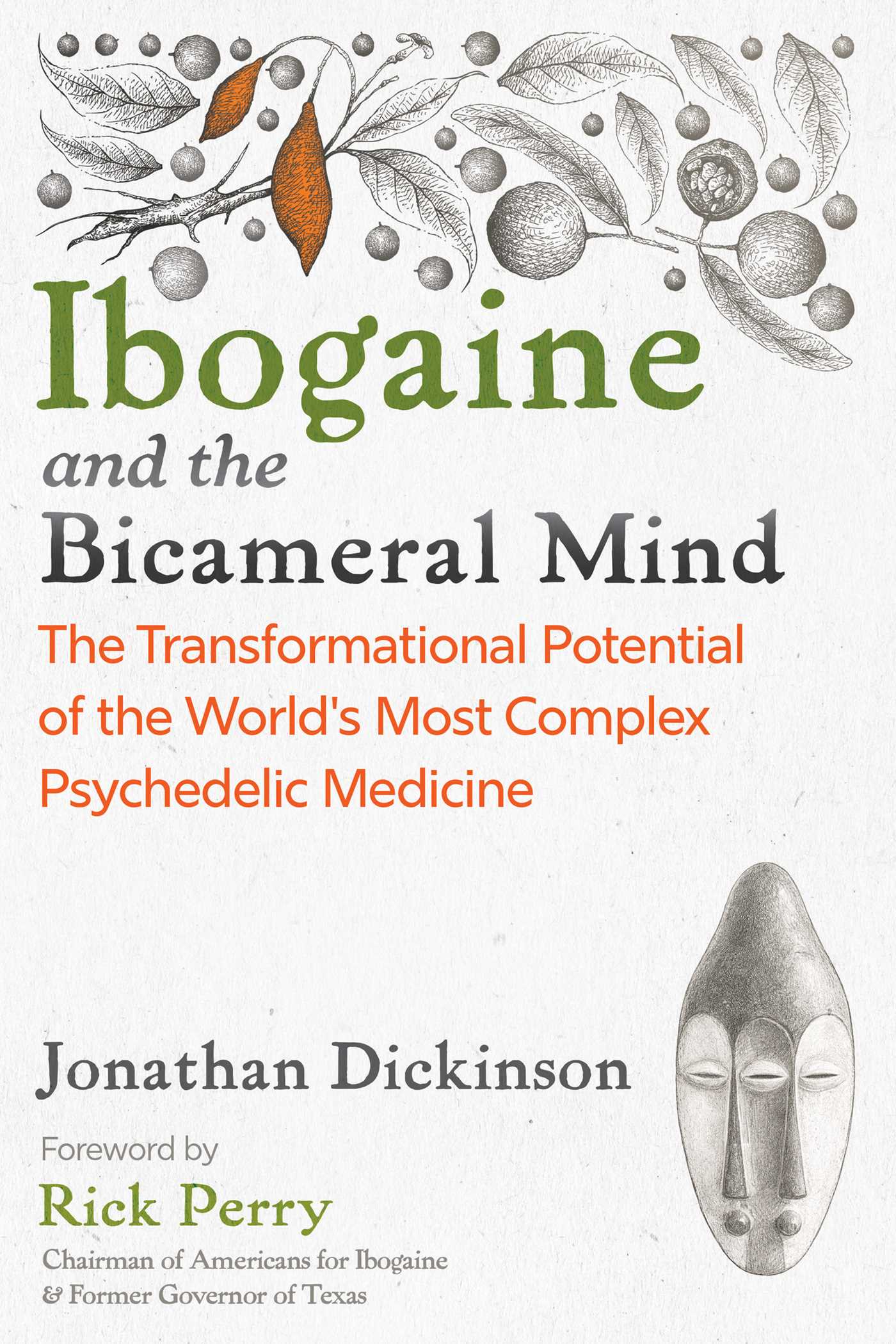
Ibogaine and the Bicameral Mind
The Transformational Potential of the World's Most Complex Psychedelic Medicine
Foreword by Rick Perry
Published by Park Street Press
Distributed by Simon & Schuster
Table of Contents
About The Book
• Explores how ibogaine works, including how it boosts cellular function,
increases neuroplasticity, and interrupts habitual behavior patterns and trauma
• Discusses the ritual roots of iboga in the Bwiti spiritual tradition of Gabon
• Shares case studies showing ibogaine’s healing effects for addiction recovery, traumatic brain injury (TBI), and Parkinson’s
Ibogaine is an alkaloid derived from the iboga plant, native to Central Africa. Its healing effects are revered within the Bwiti spiritual tradition of Gabon. International ibogaine expert Jonathan Dickinson explores how this psychedelic substance is now emerging as one of the most promising tools in neuro-regenerative medicine, addiction recovery, and treating trauma.
Grounded in fieldwork and more than 15 years of clinical observation, Dickinson shows how ibogaine interacts with the body and mind, inducing a “bicameral state” of consciousness. This is a liminal mode of being in which ancient voices, archetypes, and internal guidance systems emerge, often catalyzing a profound reorganization of memory, identity, and behavior.
He details how ibogaine boosts cellular function and shares impressive case studies to demonstrate how ibogaine has successfully treated PTSD, traumatic brain injury, Parkinson’s, neuropathic pain, and multiple sclerosis.
As a clinician scientist, Dickinson has helped a multitude of veterans with their post-traumatic mental health struggles. As a Bwiti initiate, he is able to present in this book a unique understanding and new framework for engaging with this transformational psychedelic medicine.
increases neuroplasticity, and interrupts habitual behavior patterns and trauma
• Discusses the ritual roots of iboga in the Bwiti spiritual tradition of Gabon
• Shares case studies showing ibogaine’s healing effects for addiction recovery, traumatic brain injury (TBI), and Parkinson’s
Ibogaine is an alkaloid derived from the iboga plant, native to Central Africa. Its healing effects are revered within the Bwiti spiritual tradition of Gabon. International ibogaine expert Jonathan Dickinson explores how this psychedelic substance is now emerging as one of the most promising tools in neuro-regenerative medicine, addiction recovery, and treating trauma.
Grounded in fieldwork and more than 15 years of clinical observation, Dickinson shows how ibogaine interacts with the body and mind, inducing a “bicameral state” of consciousness. This is a liminal mode of being in which ancient voices, archetypes, and internal guidance systems emerge, often catalyzing a profound reorganization of memory, identity, and behavior.
He details how ibogaine boosts cellular function and shares impressive case studies to demonstrate how ibogaine has successfully treated PTSD, traumatic brain injury, Parkinson’s, neuropathic pain, and multiple sclerosis.
As a clinician scientist, Dickinson has helped a multitude of veterans with their post-traumatic mental health struggles. As a Bwiti initiate, he is able to present in this book a unique understanding and new framework for engaging with this transformational psychedelic medicine.
Excerpt
1
The Spark That Lit the Thunder
In the secret places inaccessible to laymen, the Black Magi,
heirs of Balthazar, teach there the mysteries of existence
and non-existence.
Prince Birinda de Boudieguy,
The Secret Bible of Africa According to the Bwiti
Gabon’s sweltering heat began to envelop me from the moment I disembarked onto the jet bridge and into the musky air of the jungle. Cool beads of sweat were already collecting under the shoulder strap of my carry-on as I descended the first stairwell inside the terminal. This equatorial weather evoked memories of my recent summers living in Mexico, but the moisture here hung heavier and hotter. After growing up in Canada, this kind of climate was still exotic.
I struggled through customs with my poor French and made my way through the airport. After picking up my luggage, I was greeted with a hug from Hughes Poitevin—better known by his nickname Tatayo—a French-born Gabonese citizen, long-since integrated into local culture as deeply as a white man possibly could be. On my path to learning about the root bark of the iboga shrub, which contains one of the world’s most powerful naturally occurring psychedelics, he kept coming up as the obvious next person to know. Over the years, several of my friends had visited him for initiation into Bwiti, the main Gabonese tradition that administers iboga in ceremonies of healing and rites of passage. Between the stories that they shared and Tatayo’s numerous appearances in National Geographic and on the BBC documentaries about Gabon, he already felt like a familiar face.
“Hi! Ho! A fresh Canadian Pygmy,” he shouted with his usual style of irreverent humor. He was slender and wrinkled with age but beamed with youthful energy and a disarming smile. He originally came to Gabon for a two-week vacation back in 1971 at the age of twenty-one and fell so deeply in love with the open-hearted and artistic spirit of the people that he skipped his return flight and made it his home. He still wore subtle remnants of his hippie roots, like the beads hanging from his neck and wrapped around his wrists. I couldn’t help but note his vest layer over a loose-fitting long-sleeved shirt and his red wool beanie, all of which looked like overkill to me with the perspiration already dampening the back of my shirt. After loading my luggage into the trunk of his 1985 Land Cruiser, we made our way to Ebando, the home of the nongovernmental organization (NGO) that Tatayo founded decades earlier. The word Ebando is a Tsogho term that means “the beginning,” and the retreat center embodied its name as a starting point for countless international travelers interested in exploring Gabon and the Bwiti tradition.
The truck rumbled through the streets of Libreville, the coastal capital, with the windows rolled down and Fela Kuti blasting from a Bluetooth speaker on the dashboard. The deep sky and dark green of the palms and flora accented the aging signage on cinder block shops and faded Western clothes, a muted background for the brightly colored and intricate prints of traditional African dresses. Along the way Tatayo talked about the cultural changes he’d witnessed in the country, and why he found the colorful synthetic hair extensions that many of the local women used distasteful. It sounded a bit problematic because they were almost ubiquitous on the city streets, and I didn’t share his opinion, which he reluctantly appreciated.
Gabon is a small country with just over two million people, about a third of whom live in Libreville. The pace of urbanization and cultural change has been staggering, with many leaving hunter-gatherer lifestyles in the villages to enter the pursuit of careers and modern households in less than a generation. I asked Tatayo how many Bwiti temples made their home amid these kinds of urban neighborhoods, compared with the rest of the country.
“It’s hard to know this,” he thought for a moment. “Maybe one hundred? But they are mostly new. Some of them come for a time, and then they go. It’s more in the countryside where you find Bwiti that continues for many generations. You will see. We will go and visit the countryside too.”
One of the roads wound along the shoreline away from the city center, passing tall palace-like government buildings and some newer developments. Before long we arrived at Ebando’s small fenced-in plot next to the ocean, just on the outskirts of the city. We pulled into the yard of the naturally sheltered compound and parked in front of the entrance to a hangar-like structure with a metal roof. Several other weathered buildings surrounded an open grassy square. Outside the hangar, in a dry patch at the center of the grass, a campfire burned in broad daylight, surrounded by logs where several young people sat. One of them worked on a pile of palm leaves, carefully stripping lengths of fiber from the stems and collecting them in a pile next to a metal bucket.
On the opposite side of the clearing, along the south wall of the compound, rested a trailer raised up on metal supports. It had a covered platform strewn with unique wooden artifacts and masks and a narrow path that led through the trinkets to the small room where Tatayo lived.
We toured part of the hangar, which contained a kitchen and eating area decorated with similar artifacts and artwork and a lounge area with several couches and shelves spilling over with books left behind by visitors from all over the world. Out through the back door and down a shaded path behind the building, Tatayo handed me the key to the first in a series of small wooden guest cabins. The room had an empty shelf, a table, the necessary luxury of a floor fan, and a single bed draped with mosquito netting. I unpacked my bags and made the space my own. After the long flight, I welcomed a moment of rest. I couldn’t sleep yet, but with the faint sound of the ocean in the background, I spent some time reflecting on the winding journey that brought me here.
A LONG ROAD TO GABON
Five years before visiting Ebando, I immigrated to Mexico to work at a clinic that administered ibogaine, a psychedelic compound derived from the iboga shrub and used in centers around the world to help people detox from opioids and other drugs. For people who genuinely want to stop using illicit substances it can dramatically ease this notoriously challenging transition, removing most of the harrowing withdrawals from opioids and minimizing cravings afterward. Partly due to this association with heroin users in the throes of withdrawal, ibogaine remains the dark horse of the psychedelic world, a reputation further complicated by a number of deaths among people who have taken it, mostly attributed to preexisting cardiac complications or interactions with other drugs.
Despite the inherent risks, I found ibogaine therapy amazing to witness. For the most part, people feel a kind of inner gravity that brings them to lie down and to close their eyes. To an observer who didn’t know any better, it could appear that a patient under the effects of ibogaine was simply asleep or at least resting very quietly. But during the process people often find their attention drawn to an inner tapestry of dreamlike visualizations. This parade from the inner depths can be highly personal or highly impersonal, sometimes banal, sometimes exquisite. Many find the effects to be quite challenging, physically, mentally, or emotionally, but most remain in a prone position and gravitate to a state of neutrality, witnessing visual reveries and processing through a kind of self-psychoanalysis.
Depending on the dosage, the acute ibogaine trance can continue for upward of ten to fifteen hours, often followed by what ibogaine providers affectionately refer to as a “gray day.” Recovering from this, ibogaine’s aftereffects gradually taper off over the course of days, weeks, and sometimes months, leaving a sense of quiet, clarity, and ease. For those coming off drugs, the enduring benefits completely transform detox. The visions sometimes inspire valuable insights, but even when people don’t see anything clearly, the treatment provides physiological relief from withdrawal and cravings. This release is otherwise unheard of in early addiction recovery, where many continue to struggle with post-acute withdrawal and depression that can last a year or more.
My own interest in ibogaine came about somewhat differently. I had never used heroin or most of the things that people came to the clinics to detox from, but I did pass through a deep and dangerous depression. When I was sixteen and going through a difficult period in high school, a doctor handed me a nine-item questionnaire printed on cardstock with a Zoloft logo in the header. Unsurprisingly, my answers landed me a prescription for Zoloft, a standard selective serotonin reuptake inhibitor (SSRI) designed to increase the amount of serotonin in my system.
Two years and two different SSRI medications later, as the doctors fiddled with my prescription, I realized the professionals didn’t know what they were doing and quit cold turkey. The long valley of the withdrawal left me in a state of depersonalization, or derealization, during which I had difficulty grasping whether I or the world around me was real. Psychedelics like psilocybin mushrooms and LSD helped me to emerge from that broken state and come alive again, but remnants of confusion and mental obsession continued to impact my life as I moved forward.
The Spark That Lit the Thunder
In the secret places inaccessible to laymen, the Black Magi,
heirs of Balthazar, teach there the mysteries of existence
and non-existence.
Prince Birinda de Boudieguy,
The Secret Bible of Africa According to the Bwiti
Gabon’s sweltering heat began to envelop me from the moment I disembarked onto the jet bridge and into the musky air of the jungle. Cool beads of sweat were already collecting under the shoulder strap of my carry-on as I descended the first stairwell inside the terminal. This equatorial weather evoked memories of my recent summers living in Mexico, but the moisture here hung heavier and hotter. After growing up in Canada, this kind of climate was still exotic.
I struggled through customs with my poor French and made my way through the airport. After picking up my luggage, I was greeted with a hug from Hughes Poitevin—better known by his nickname Tatayo—a French-born Gabonese citizen, long-since integrated into local culture as deeply as a white man possibly could be. On my path to learning about the root bark of the iboga shrub, which contains one of the world’s most powerful naturally occurring psychedelics, he kept coming up as the obvious next person to know. Over the years, several of my friends had visited him for initiation into Bwiti, the main Gabonese tradition that administers iboga in ceremonies of healing and rites of passage. Between the stories that they shared and Tatayo’s numerous appearances in National Geographic and on the BBC documentaries about Gabon, he already felt like a familiar face.
“Hi! Ho! A fresh Canadian Pygmy,” he shouted with his usual style of irreverent humor. He was slender and wrinkled with age but beamed with youthful energy and a disarming smile. He originally came to Gabon for a two-week vacation back in 1971 at the age of twenty-one and fell so deeply in love with the open-hearted and artistic spirit of the people that he skipped his return flight and made it his home. He still wore subtle remnants of his hippie roots, like the beads hanging from his neck and wrapped around his wrists. I couldn’t help but note his vest layer over a loose-fitting long-sleeved shirt and his red wool beanie, all of which looked like overkill to me with the perspiration already dampening the back of my shirt. After loading my luggage into the trunk of his 1985 Land Cruiser, we made our way to Ebando, the home of the nongovernmental organization (NGO) that Tatayo founded decades earlier. The word Ebando is a Tsogho term that means “the beginning,” and the retreat center embodied its name as a starting point for countless international travelers interested in exploring Gabon and the Bwiti tradition.
The truck rumbled through the streets of Libreville, the coastal capital, with the windows rolled down and Fela Kuti blasting from a Bluetooth speaker on the dashboard. The deep sky and dark green of the palms and flora accented the aging signage on cinder block shops and faded Western clothes, a muted background for the brightly colored and intricate prints of traditional African dresses. Along the way Tatayo talked about the cultural changes he’d witnessed in the country, and why he found the colorful synthetic hair extensions that many of the local women used distasteful. It sounded a bit problematic because they were almost ubiquitous on the city streets, and I didn’t share his opinion, which he reluctantly appreciated.
Gabon is a small country with just over two million people, about a third of whom live in Libreville. The pace of urbanization and cultural change has been staggering, with many leaving hunter-gatherer lifestyles in the villages to enter the pursuit of careers and modern households in less than a generation. I asked Tatayo how many Bwiti temples made their home amid these kinds of urban neighborhoods, compared with the rest of the country.
“It’s hard to know this,” he thought for a moment. “Maybe one hundred? But they are mostly new. Some of them come for a time, and then they go. It’s more in the countryside where you find Bwiti that continues for many generations. You will see. We will go and visit the countryside too.”
One of the roads wound along the shoreline away from the city center, passing tall palace-like government buildings and some newer developments. Before long we arrived at Ebando’s small fenced-in plot next to the ocean, just on the outskirts of the city. We pulled into the yard of the naturally sheltered compound and parked in front of the entrance to a hangar-like structure with a metal roof. Several other weathered buildings surrounded an open grassy square. Outside the hangar, in a dry patch at the center of the grass, a campfire burned in broad daylight, surrounded by logs where several young people sat. One of them worked on a pile of palm leaves, carefully stripping lengths of fiber from the stems and collecting them in a pile next to a metal bucket.
On the opposite side of the clearing, along the south wall of the compound, rested a trailer raised up on metal supports. It had a covered platform strewn with unique wooden artifacts and masks and a narrow path that led through the trinkets to the small room where Tatayo lived.
We toured part of the hangar, which contained a kitchen and eating area decorated with similar artifacts and artwork and a lounge area with several couches and shelves spilling over with books left behind by visitors from all over the world. Out through the back door and down a shaded path behind the building, Tatayo handed me the key to the first in a series of small wooden guest cabins. The room had an empty shelf, a table, the necessary luxury of a floor fan, and a single bed draped with mosquito netting. I unpacked my bags and made the space my own. After the long flight, I welcomed a moment of rest. I couldn’t sleep yet, but with the faint sound of the ocean in the background, I spent some time reflecting on the winding journey that brought me here.
A LONG ROAD TO GABON
Five years before visiting Ebando, I immigrated to Mexico to work at a clinic that administered ibogaine, a psychedelic compound derived from the iboga shrub and used in centers around the world to help people detox from opioids and other drugs. For people who genuinely want to stop using illicit substances it can dramatically ease this notoriously challenging transition, removing most of the harrowing withdrawals from opioids and minimizing cravings afterward. Partly due to this association with heroin users in the throes of withdrawal, ibogaine remains the dark horse of the psychedelic world, a reputation further complicated by a number of deaths among people who have taken it, mostly attributed to preexisting cardiac complications or interactions with other drugs.
Despite the inherent risks, I found ibogaine therapy amazing to witness. For the most part, people feel a kind of inner gravity that brings them to lie down and to close their eyes. To an observer who didn’t know any better, it could appear that a patient under the effects of ibogaine was simply asleep or at least resting very quietly. But during the process people often find their attention drawn to an inner tapestry of dreamlike visualizations. This parade from the inner depths can be highly personal or highly impersonal, sometimes banal, sometimes exquisite. Many find the effects to be quite challenging, physically, mentally, or emotionally, but most remain in a prone position and gravitate to a state of neutrality, witnessing visual reveries and processing through a kind of self-psychoanalysis.
Depending on the dosage, the acute ibogaine trance can continue for upward of ten to fifteen hours, often followed by what ibogaine providers affectionately refer to as a “gray day.” Recovering from this, ibogaine’s aftereffects gradually taper off over the course of days, weeks, and sometimes months, leaving a sense of quiet, clarity, and ease. For those coming off drugs, the enduring benefits completely transform detox. The visions sometimes inspire valuable insights, but even when people don’t see anything clearly, the treatment provides physiological relief from withdrawal and cravings. This release is otherwise unheard of in early addiction recovery, where many continue to struggle with post-acute withdrawal and depression that can last a year or more.
My own interest in ibogaine came about somewhat differently. I had never used heroin or most of the things that people came to the clinics to detox from, but I did pass through a deep and dangerous depression. When I was sixteen and going through a difficult period in high school, a doctor handed me a nine-item questionnaire printed on cardstock with a Zoloft logo in the header. Unsurprisingly, my answers landed me a prescription for Zoloft, a standard selective serotonin reuptake inhibitor (SSRI) designed to increase the amount of serotonin in my system.
Two years and two different SSRI medications later, as the doctors fiddled with my prescription, I realized the professionals didn’t know what they were doing and quit cold turkey. The long valley of the withdrawal left me in a state of depersonalization, or derealization, during which I had difficulty grasping whether I or the world around me was real. Psychedelics like psilocybin mushrooms and LSD helped me to emerge from that broken state and come alive again, but remnants of confusion and mental obsession continued to impact my life as I moved forward.
Product Details
- Publisher: Park Street Press (September 8, 2026)
- Length: 512 pages
- ISBN13: 9798888504697
Raves and Reviews
“From the jungles of Gabon to Navy SEAL recovery programs, this transformative guide reveals ibogaine’s potential to bridge spirituality and science, challenging conventional psychiatry and offering hope for those seeking radical healing. A must-read for anyone fascinated by psychedelics, consciousness, and the future of mental health.”
– Norman Ohler, New York Times bestselling author of Blitzed: Drugs in Nazi Germany
“I’ve personally gone through ibogaine treatment, as have many of my teammates. The impact was life-changing and, in some cases, life-saving. Jonathan Dickinson isn’t a theorist; he’s a long-time researcher and clinician who has guided thousands through this work. If you’re a veteran, first responder, mental health professional, or anyone searching for real answers around trauma and healing, Ibogaine and the Bicameral Mind is a must-read. I’m living proof this medicine can help you navigate the darkest moments of your life, when it’s done right, with the right people guiding you.”
– DJ Shipley, veteran Navy SEAL and cofounder of GBRS (Global Battlefield Research Solutions) Group
“Ibogaine is a traditional medicine derived from an African shrub that has been used in the healing rituals of the Bwiti tribe of Gabon for centuries. This remarkable medicine promises to revolutionize the treatment of addiction, traumatic brain injuries, cognitive deficits, even Parkinson’s. Jonathan Dickinson is a clinician and entrepreneur who has labored for years to bring ibogaine and its healing potential to the West. This book describes his quest, which is bearing fruit at long last.”
– Dennis J. McKenna PhD, ethnopharmacologist, president and founder of McKenna Academy
“Ibogaine and the Bicameral Mind is the most bold and comprehensive work on ibogaine to date, written by one of the field’s most authoritative voices. Jonathan Dickinson brings rare depth as a clinician scientist, Bwiti initiate, and clinic operator, while pioneering Nagoya-compliant frameworks and medical guidance. He masterfully weaves history, neuroscience, psychoanalysis, and lived experience into a thought-provoking and beautifully written narrative that reshapes how we understand ibogaine and stands as a landmark contribution to the field.”
– Joseph Peter Barsuglia, PhD, clinical psychologist, psychedelic medicine and integrative wellness ad
“As a former Navy SEAL turned executive and mental health advocate, I’ve seen firsthand how shallow most conversations about trauma, addiction, and ‘treatment’ really are. Ibogaine and the Bicameral Mind is the first book I’ve read that does justice to the complexity of this medicine and the people who seek it, fusing Indigenous wisdom, hard neuroscience, and lived experience in a way that actually serves those of us on the front lines of this crisis. If you care about real healing for warfighters, athletes, and high performers—not just symptom management—you need to read this book."
– Marcus Capone, veteran Navy SEAL and founder and CEO of TARA Mind Inc. mental health therapies
“Only a handful of practitioners in the ibogaine community possess the depth of understanding, integrity, traditional respect, and real-world experience necessary to write a book of this scope. I feel profound relief that there is finally a work that authentically and rigorously spans Bwiti traditional practice, ibogaine therapy, and their shared history—a book that honors both the medicine and the culture from which it comes.”
– Tricia Eastman, author of Seeding Consciousness, initiated Bwiti Fang traditional practitioner, and
Resources and Downloads
High Resolution Images
-
Book Cover Image (jpg): Ibogaine and the Bicameral Mind
eBook 9798888504697