
Get our latest book recommendations, author news, and competitions right to your inbox.
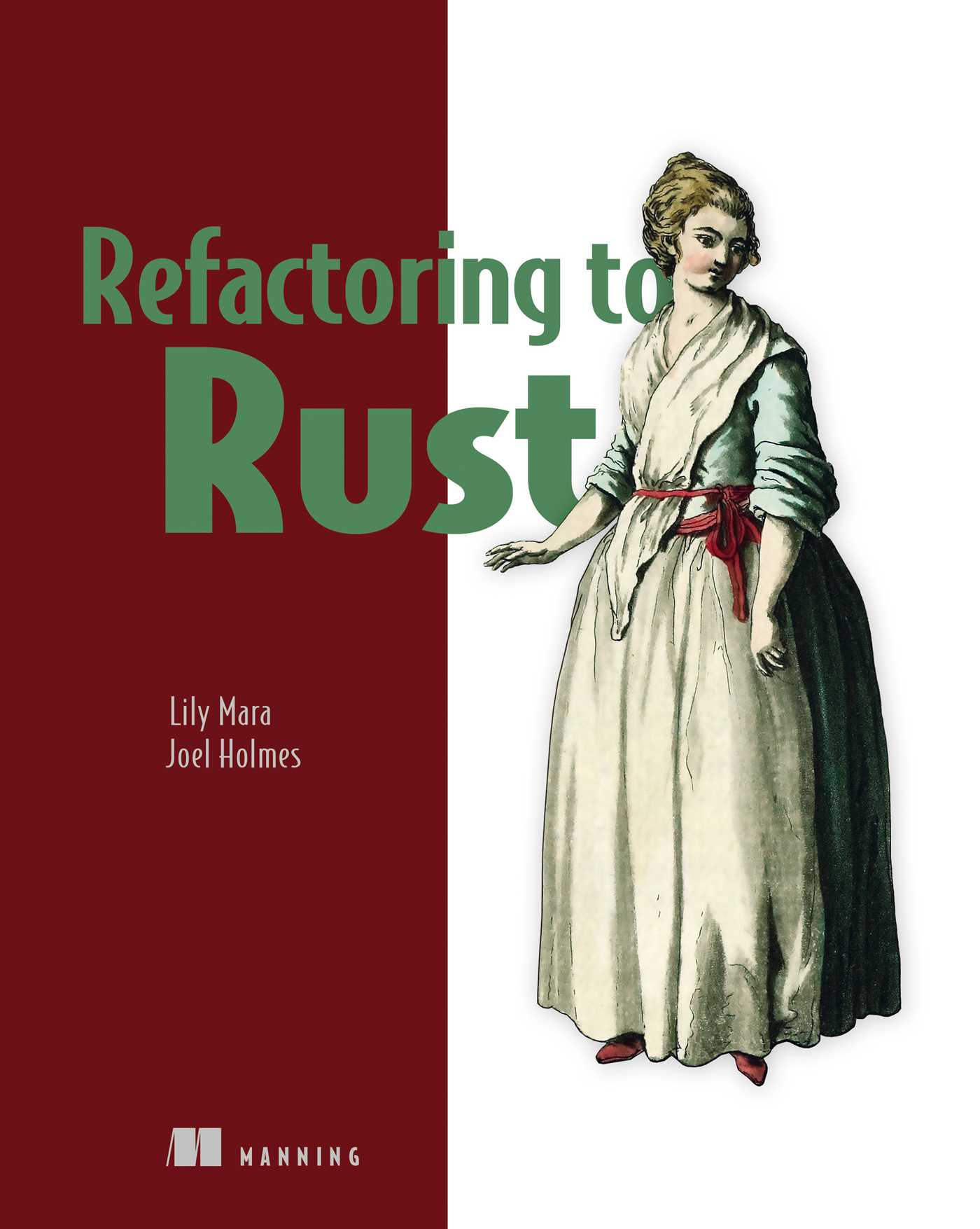
Refactoring to Rust
By Lily Mara and Joel Holmes
Published by Manning
Distributed by Simon & Schuster
Table of Contents
About The Book
Don’t rewrite from scratch! Improve your software speed and scalability by iteratively replacing performance-critical code with Rust
Refactoring to Rust helps you get the speed and reliability of Rust libraries, functions, and high-performance features without needing a complete rewrite of your codebase.
In Refactoring to Rust you will learn to:
• Create Rust libraries you can call from other programming languages
• Integrate Rust functions with code in other languages
• Use Rust’s ownership and borrowing system to write high performance code
• Handle errors as values using Rust’s enums
• Minimize unnecessary memory usage with Rust’s multiple string types
• Boost performance with Rust concurrency and async event processing
• Create Rust HTTP services
Rust is designed to gradually replace other languages by integrating and decomposing existing code. Refactoring to Rust helps you take full advantage of this amazing feature, even if you’ve never coded in Rust before. You’ll learn practical code-mixing techniques like embedding Rust libraries into apps written in other languages.
About the technology
Upgrade your software without starting from scratch! By incrementally introducing Rust into your codebase, you can upgrade key features and improve the performance of almost any application. This book shows you how to create standalone Rust libraries, boost speed and stability by using Rust for concurrency, and create safe, memory-efficient low-level code.
About the book
Refactoring to Rust shows you exactly where and how to integrate Rust surgically into applications written in another language. You’ll start by reviewing Rust’s unique syntax and concepts, with special emphasis on unique language features like variable lifetime and ownership. Then, you’ll learn to use Rust to wrap dangerous code, call standard and custom Rust libraries, and even use WASM to run Rust in the browser.
What’s inside
• Create Rust libraries you can call from other languages
• Handle errors as values using Rust’s enums
• Optimize for memory efficiency
• Boost performance with Rust concurrency
About the reader
For intermediate programmers. No Rust experience required.
About the author
Lily Mara is a software engineer focused on high-performance Rust applications. Joel Holmes is a software developer building cloud native applications. He is the Author of Shipping Go, and Co-Author of Go in Action, Second Edition.
Refactoring to Rust helps you get the speed and reliability of Rust libraries, functions, and high-performance features without needing a complete rewrite of your codebase.
In Refactoring to Rust you will learn to:
• Create Rust libraries you can call from other programming languages
• Integrate Rust functions with code in other languages
• Use Rust’s ownership and borrowing system to write high performance code
• Handle errors as values using Rust’s enums
• Minimize unnecessary memory usage with Rust’s multiple string types
• Boost performance with Rust concurrency and async event processing
• Create Rust HTTP services
Rust is designed to gradually replace other languages by integrating and decomposing existing code. Refactoring to Rust helps you take full advantage of this amazing feature, even if you’ve never coded in Rust before. You’ll learn practical code-mixing techniques like embedding Rust libraries into apps written in other languages.
About the technology
Upgrade your software without starting from scratch! By incrementally introducing Rust into your codebase, you can upgrade key features and improve the performance of almost any application. This book shows you how to create standalone Rust libraries, boost speed and stability by using Rust for concurrency, and create safe, memory-efficient low-level code.
About the book
Refactoring to Rust shows you exactly where and how to integrate Rust surgically into applications written in another language. You’ll start by reviewing Rust’s unique syntax and concepts, with special emphasis on unique language features like variable lifetime and ownership. Then, you’ll learn to use Rust to wrap dangerous code, call standard and custom Rust libraries, and even use WASM to run Rust in the browser.
What’s inside
• Create Rust libraries you can call from other languages
• Handle errors as values using Rust’s enums
• Optimize for memory efficiency
• Boost performance with Rust concurrency
About the reader
For intermediate programmers. No Rust experience required.
About the author
Lily Mara is a software engineer focused on high-performance Rust applications. Joel Holmes is a software developer building cloud native applications. He is the Author of Shipping Go, and Co-Author of Go in Action, Second Edition.
About The Authors
Lily Mara is a Senior Software Engineer at OneSignal, where she writes high-performance Rust code full time. She has been using Rust since before the release of version 1.0, and has created multiple Rust libraries designed to be integrated into existing production applications.
Joel Holmes is a software developer focused on building cloud native applications. He has worked at several start-ups helping architect, design, and develop new products and services to help those companies develop and grow. Along the way, he was able to help establish tools and processes that helped development and increase quality. Joel is an Open Source contributor, including to DevOps projects that are written in Go such as VMWare's Carvel-vendir.
Product Details
- Publisher: Manning (August 5, 2025)
- Length: 304 pages
- ISBN13: 9781638350163
Resources and Downloads
High Resolution Images
-
Book Cover Image (jpg): Refactoring to Rust
eBook 9781638350163
-
Author Photo (jpg): Joel Holmes
(0.1 MB)
Any use of an author photo must include its respective photo credit