Get our latest book recommendations, author news, and competitions right to your inbox.
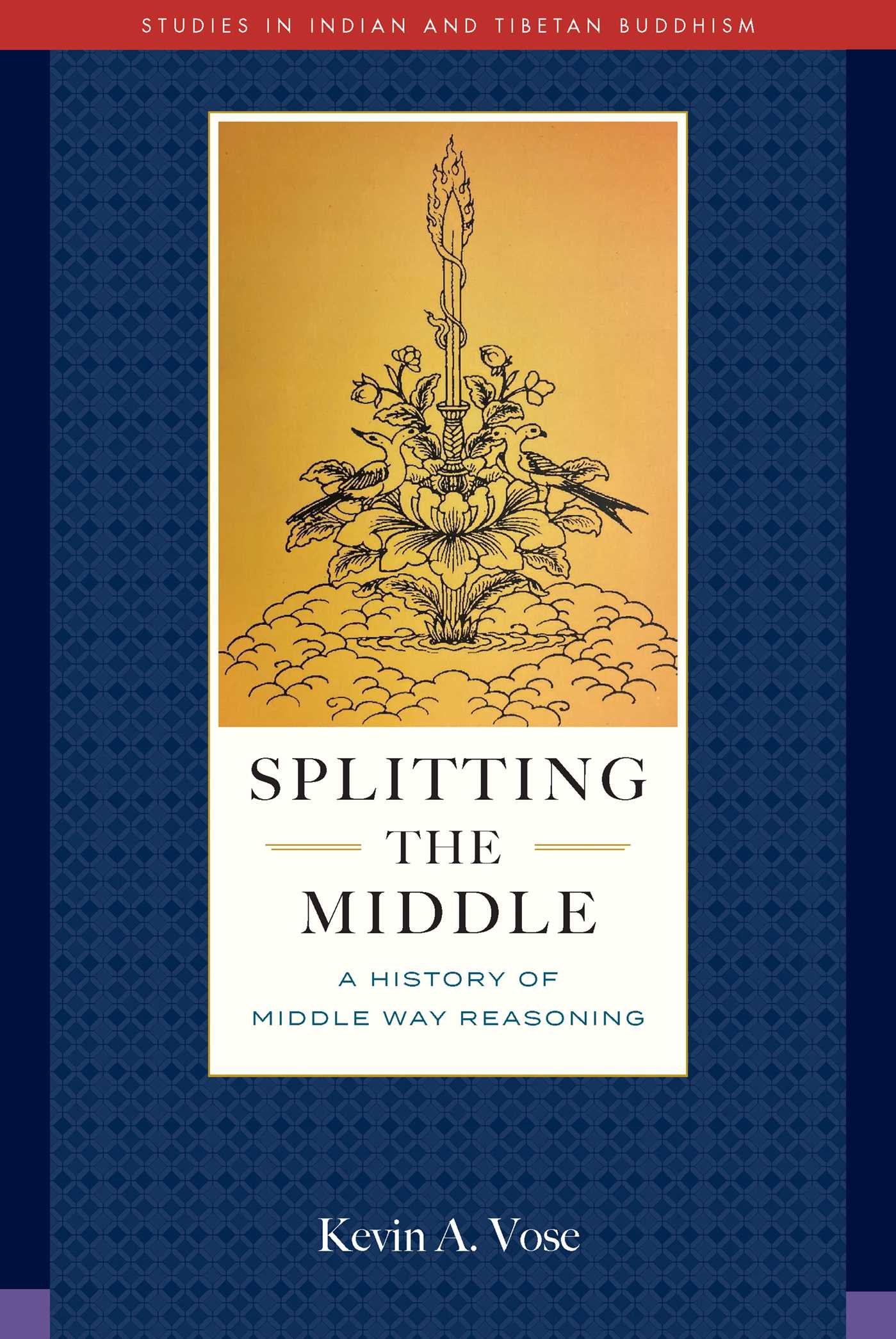
Splitting the Middle
A History of Middle Way Reasoning
Published by Wisdom Publications
Distributed by Simon & Schuster
Table of Contents
About The Book
Discover how Patsab Nyima Drak created the foremost form of Buddhist philosophy, the Prasangika interpretation of the Middle Way, from the works of the famed Indian philosopher Candrakirti.
This book traces how Buddhist philosophers Bhaviveka and Candrakirti (ca. sixth–seventh centuries) understood key Buddhist epistemological questions: how to prove the central Middle Way claim that all things are empty of intrinsic nature, the correct use of svatantra inference, and the role of arguments by “consequence” (prasanga). These arguments saw further refinement in the works of eighth-century thinkers Santaraksita and Kamalasila, who were instrumental in transmitting the Middle Way from India to Tibet. Together, these figures inspired the twelfth-century renaissance of the Middle Way in Tibet, where the differences between their viewpoints became the basis for two philosophical schools—Prasangika and Svatantrika—named for their chosen forms of argumentation.
Patsab Nyima Drak (ca. 1070–1145), the Tibetan translator of Candrakirti’s major works, and his disciples Shang Thangsakpa, Khuton Dode Bar, and Maja Jangchup Tsondru, together with the Kashmiri Jayananda, forged a systematic interpretation of the Middle Way and the Mahayana Buddhist path to awakening. They saw Candrakirti’s arguments by consequence to be central in overcoming the twin delusions of holding philosophical positions and seeing things as having intrinsic natures. Championing Candrakirti’s austere vision of transformation, these creators of Prasangika argued that proper reasoning and contemplation induce a radical break with consciousness that enables the practitioner to become a buddha.
This examination of the first Prasangikas casts this reading of the Middle Way in new light, challenging contemporary interpretations that present it as a form of skepticism. Splitting the Middle argues that Prasangika constitutes a thoroughgoing challenge to the validity of mental states and ways of knowing.
This book traces how Buddhist philosophers Bhaviveka and Candrakirti (ca. sixth–seventh centuries) understood key Buddhist epistemological questions: how to prove the central Middle Way claim that all things are empty of intrinsic nature, the correct use of svatantra inference, and the role of arguments by “consequence” (prasanga). These arguments saw further refinement in the works of eighth-century thinkers Santaraksita and Kamalasila, who were instrumental in transmitting the Middle Way from India to Tibet. Together, these figures inspired the twelfth-century renaissance of the Middle Way in Tibet, where the differences between their viewpoints became the basis for two philosophical schools—Prasangika and Svatantrika—named for their chosen forms of argumentation.
Patsab Nyima Drak (ca. 1070–1145), the Tibetan translator of Candrakirti’s major works, and his disciples Shang Thangsakpa, Khuton Dode Bar, and Maja Jangchup Tsondru, together with the Kashmiri Jayananda, forged a systematic interpretation of the Middle Way and the Mahayana Buddhist path to awakening. They saw Candrakirti’s arguments by consequence to be central in overcoming the twin delusions of holding philosophical positions and seeing things as having intrinsic natures. Championing Candrakirti’s austere vision of transformation, these creators of Prasangika argued that proper reasoning and contemplation induce a radical break with consciousness that enables the practitioner to become a buddha.
This examination of the first Prasangikas casts this reading of the Middle Way in new light, challenging contemporary interpretations that present it as a form of skepticism. Splitting the Middle argues that Prasangika constitutes a thoroughgoing challenge to the validity of mental states and ways of knowing.
Product Details
- Publisher: Wisdom Publications (April 28, 2026)
- Length: 552 pages
- ISBN13: 9798890700131
Raves and Reviews
“A remarkable, trailblazing monograph, philologically sound and brilliantly analyzed. Kevin Vose soars with an eagle’s penetrating sight over the vast Madhyamaka landscape, taking the reader from the Indian sources of the school’s later Svatantrika-Prasa?gika divide to a panoramic view of the logical and epistemological routes that contributed to the development of the Svatantrika position, and finally across the Himalayas to Tibet, to the opposing cliffs of the interpretative chasm. Vose’s investigation, however, goes beyond clarifying the issues involved in the historical Svatantrika-Prasa?gika debate. Highlighting the Prasa?gika understanding of emptiness, he exposes the problems inherent in the contemporary skeptical, semantic, deflationist, and conventionalist interpretations of Madhyamaka. This impressive contribution is essential reading for all interested in Madhyamaka.”
– Anne MacDonald, Institute for the Cultural and Intellectual History of Asia, Austrian Academy of Sciences
“Scholars will admire Vose’s clear, detailed, oftentimes groundbreaking investigation of primary sources—including newly accessible works of Patsab and others found in the “bKa' gdams gsung 'bum” collection—and Vose’s deep critical engagement with contemporary etic Madhyamika studies. This is a significant contribution to our understanding of Indian and Tibetan Madhyamika thought in general. It is required reading for scholars interested in the later evolution of the Madhyamika school in India and its reception in Tibet.”
– John Newman, John D. and Catherine T. MacArthur Professor Emeritus of Asian Religions, New College of Florida (pre-2023 version)
Resources and Downloads
High Resolution Images
-
Book Cover Image (jpg): Splitting the Middle
eBook 9798890700131