Get our latest book recommendations, author news, and competitions right to your inbox.
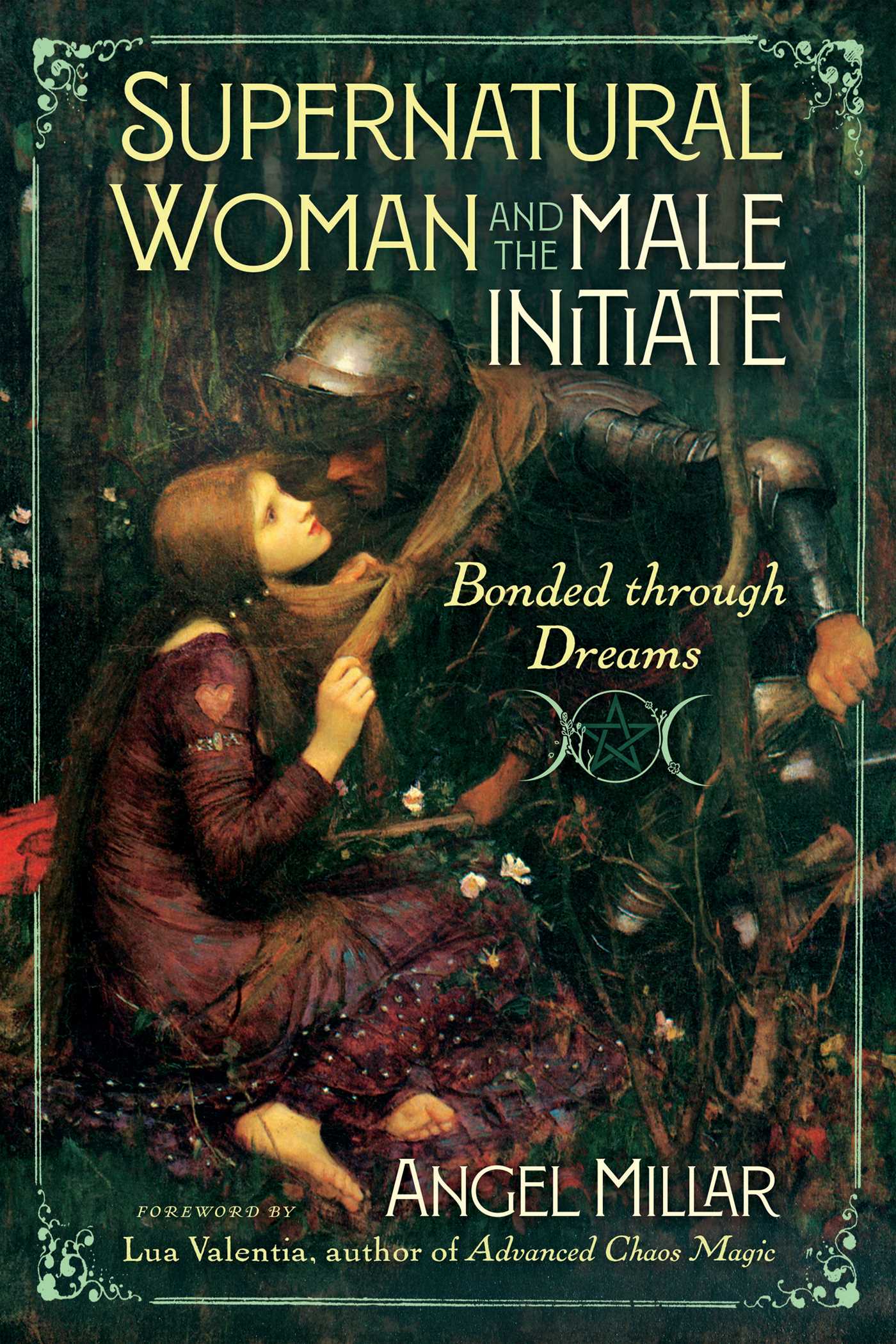
Supernatural Woman and the Male Initiate
Bonded through Dreams
By Angel Millar
Foreword by Lua Valentia
Published by Inner Traditions
Distributed by Simon & Schuster
Table of Contents
About The Book
• Explores the supernatural woman as the active agent of the male initiate’s spiritual transformation
• Traces the supernatural woman’s presence in ancient Greek and Zoroastrian traditions, the Eddas, the Icelandic sagas, and the works of the great medieval English poet and author Geoffrey Chaucer
• Details the similarities between sexual ecstasy and the mystical state by exploring the role of ecstasy in magical and spiritual practice
The phenomenon of the relationship between the feminine force and her male devotee is documented in myth, religion, and art, but the spiritual woman herself remains a mystery. As muse, sorceress, and Valkyrie, she guides the man’s development and tests his resolve. She converses through dreams, bestows poetry and prophecy, and initiates spiritual transformation through sexual encounters.
Angel Millar explores this magical relationship by drawing upon ancient Greek and Zoroastrian traditions, Scandinavian Eddas and sagas, and Chaucer’s tale of the Wife of Bath. Millar traces evidence of the supernatural woman’s presence in fine art, ancient sexual symbolism, Wicca, Freemasonry, and psychology—most notably Jung’s theory of the anima and animus and Freud’s life and death instincts.
Comparing sexual ecstasy and the mystical state, Millar reveals the unique role of ecstasy in magical and spiritual practice. Bringing in feminine perspectives on this radical transformation, he looks at the religious eroticism of St. Teresa and 13th-century English Christian mystic Margery Kempe as well as Aleister Crowley’s Lust tarot card, illustrated by Lady Frieda Harris. Millar then breaks down the fundamental aspects of initiation depicted in these wide-ranging examples, showing how to welcome this mystical muse to unlock the inspiration she offers and the heroic drive within.
• Traces the supernatural woman’s presence in ancient Greek and Zoroastrian traditions, the Eddas, the Icelandic sagas, and the works of the great medieval English poet and author Geoffrey Chaucer
• Details the similarities between sexual ecstasy and the mystical state by exploring the role of ecstasy in magical and spiritual practice
The phenomenon of the relationship between the feminine force and her male devotee is documented in myth, religion, and art, but the spiritual woman herself remains a mystery. As muse, sorceress, and Valkyrie, she guides the man’s development and tests his resolve. She converses through dreams, bestows poetry and prophecy, and initiates spiritual transformation through sexual encounters.
Angel Millar explores this magical relationship by drawing upon ancient Greek and Zoroastrian traditions, Scandinavian Eddas and sagas, and Chaucer’s tale of the Wife of Bath. Millar traces evidence of the supernatural woman’s presence in fine art, ancient sexual symbolism, Wicca, Freemasonry, and psychology—most notably Jung’s theory of the anima and animus and Freud’s life and death instincts.
Comparing sexual ecstasy and the mystical state, Millar reveals the unique role of ecstasy in magical and spiritual practice. Bringing in feminine perspectives on this radical transformation, he looks at the religious eroticism of St. Teresa and 13th-century English Christian mystic Margery Kempe as well as Aleister Crowley’s Lust tarot card, illustrated by Lady Frieda Harris. Millar then breaks down the fundamental aspects of initiation depicted in these wide-ranging examples, showing how to welcome this mystical muse to unlock the inspiration she offers and the heroic drive within.
Excerpt
INTRODUCTION
COURTING THE SUPERNATURAL WOMAN
It is no coincidence that the opening words of Homer’s Iliad are “Sing, O goddess” nor that his Odyssey opens, similarly, with “Tell me, O muse.” In both cases, Homer (eighth or ninth century BCE) invokes a divine female being so that she might speak to him and that he might record her words. We should not make the mistake of believing that Homer is speaking metaphorically. For ancient man, the muse was closer to the gods and goddesses than to man, and—like them, and like us—entirely real. Intoxicating, such divine beings inspired devotion and would, at times, confer eloquence and even the ability to prophesize on her devotees.
We find such a supernatural or otherworldly woman appearing elsewhere, including Zoroastrianism, the Norse sagas, the Icelandic Prose and Poetic Eddas, and medieval English legends, folklore, and stories. We see the reemergence or reflection—albeit sometimes unsatisfactorily—of the supernatural woman in contemporary neopaganism (especially the initiation rituals of Wicca), Western Left-hand path occultism, Carl Jung’s theory of the “anima,” fine art, and, perhaps occasionally, in our own dreams.
In my own case, some of my first spiritual experiences were in neopaganism, on the outskirts of Kent and London, England. The belief that primordial spiritual forces underpin seemingly mundane life was of enormous value to my personal awakening but I disliked what I regarded as rank hypocrisy within the neopagan group I participated in. The goddess and the priestess were exalted, verbally, but, so often, it seemed, they were exalted only as part of some sort of underhand sexual agenda. Genuine respect and reverence seemed to be absent.
By the age of nineteen, I had disassociated myself from this world. In search of something more serious, I was initiated into the Illuminates of Thanateros (IOT) by Peter J. Carroll (author of Liber Null & Psychonaut, among other books), in Temple Misanthropy, in the Elephant and Castle, London. At the time, musician Ian Read was its Magister Templi. Later still, I was initiated into Freemasonry and the Societas Rosicruciana in Civitatibus Foederatis, among other societies.
Although viewed with suspicion by contemporary society, the initiation of men by other men is ancient and, I would suggest, essential for the healthy development of the male psyche and emotional life. For a few decades, this was the only type of initiation that concerned me. Then, a few years before writing this book, something strange happened—a beautiful raven-haired woman began appearing in my dreams. She would stand there, as if alerting me to the importance of the dream. I regarded her as my fylgja—a type of supernatural woman spoken of in medieval Icelandic literature, which preserved Old Norse myths and legends. A man’s fylgja often appeared to him in dreams and at death and was inseparable from his hamingja (“luck”).
I had had a recurring nightmare for many years. Around this time, one night or early morning, asleep, I felt myself slipping into the nightmare when, suddenly, a beautiful, naked, supernatural woman wrapped herself around me in my dream. Her act was not sexual but protective. The nightmare never returned. Our tendency to rationalize everything away would undoubtedly cause many to argue that the woman in the dream, and the dream itself, was purely a psychological phenomenon. However, if it is, I do not think it is a phenomenon recognized by psychology. Certainly, it seemed as if the dream woman acted autonomously to my psyche, which was filling with dread.
Around the same time, I was practicing self-hypnosis and what might—rather inadequately—be called “automatic writing.” Through the writings, a personality emerged, which—decoding the words, seemingly spoken from the beyond—I identified with a rather obscure goddess. Thus, I began to realize that if the initiation of men by other men is essential, it is also not the end, at least, not for some initiates. “Not every man has a fylgja;” says Ingrid Fischer (1950–2020) in Soul Lore of the North: Toward a Synthesis of Jungian Psychology and the Way of the Hero, “some men have a very weak and underdeveloped one, but powerful men have a strong fylgja.”1
I first met Fischer, in 1990 along with Read (her husband) and Nick (who, at twenty-seven, was the youngest member of the temple), at a meet-and-greet for prospective members of the IOT, at a pub in Pimlico, London. I lost contact with all of the members after I resigned in 1991. Over thirty years later, after completing the writing of this book, I learned that she had written a book related to the fylgja. Struck by the fact that we had written about the same obscure subject, I was very keen to read it. After a diligent search, however, I was unable to locate a copy anywhere and gave up any hope of reading it. A couple of weeks later, however, a publisher contacted me, asked me if I could write an endorsement for a new edition of the book, and sent me the manuscript. I suspect Fischer would say that our hamingja—which can be partially transmitted from one person to another—became intertwined in the turbulent and chaotic years of 1990 and 1991, and that its effects emerged decades later.
Writing Supernatural Woman and the Male Initiate was an act of magic (and magic, as we have already alluded to with our reference to Homer and his muse, is, of course, often associated with writing and speech). Not only did this book demand going deep within my own soul, and within the primordial, to understand the supernatural woman, it seemed to reward that Hadean descent with strange and remarkable coincidences (or to use a Jungian term, synchronicities). These have changed my life in dramatic and formerly unthinkable ways. When we examine the literature and myths of the supernatural woman, we find that she has always had such an effect on the life of the initiate. To court her is to flirt with tragedy, desire, total transformation, magic, mysteries, and the genius. The weeds of modernity—its rationalizing, its disdain for timeless beauty, its inability to understand the symbolic, and its inability to recognize the sacred—have intruded upon her pathways, obscuring them to all but those who can still dream.
In A Moment’s Ornament: The Practice of Nympholepsy in Ancient Greece, Corinne Ondine Pache claims that, in relation to Greek mythology, we see two patterns of interactions between goddesses and mortal men: “the abduction and the mourning model.”2 The former, says Pache, “finds its origins in the Indo-European dawn goddess who abducts her lovers” while the latter “can be traced back to an ancient Near Eastern model.”3 Although we are not concerned with these models we cannot help but notice the antiquity of the belief that a divine female being can, and sometimes will, descend to unite with a man (usually a warrior). Hence, in the Gilgamesh epic of ancient Mesopotamia (circa 2,000 BCE), the goddess Ishtar tries to seduce the hero (Gilgamesh) and asks him to be her husband.4 While we will focus on the relationship of the earthly man and the magical woman, we should note that earthly women, too, were occasionally said to be sexually involved with a divine male being. Although of a much later date than Homer, in the medieval Icelandic tale of the pagan Gunnar helmingr, he flees Norway (which is ruled by a Christian king) and travels to Sweden, where a beautiful woman attends to a statue of the god Frey, and is considered by the local people to be his wife.5 Again, in the medieval Icelandic Poetic Edda, Rig (i.e., the Old Norse god Heimdall) travels across the land, and impregnates three women. Nine months later, these women give birth to the first in the line of the thrall, peasant, and warrior castes.
Notably, sex between the god and the woman is, in every case, immediately preceded by the statement that he “knew well / wise words to speak”6 or that he gave “good counsel.”7 Nevertheless, rather than being mere advice, it is as if the words of the god are an enchantment, causing the sexual relationship to commence.
Throughout this book, we will see that sexual relations between a female deity or divine being and her human disciple is intimately associated with poetry and magic, though occasionally, we find that the gift of poetry is said to be conferred by a supernatural being of the same sex. Hence, the Anglo-Saxon monk Bede claimed that Cadmon was turned into a great poet by a man who appeared in his dream and commanded him to “sing me something” (sing me hwathwugu).8 Having no skill in poetry prior to the dream, Cadmon was able to compose poems and songs afterward so long as the theme was pious.
While her study, like ours, is concerned with the relationship of the supernatural female being to the human man, Pache notes the ambiguity of the ancient Greek term nymphe, which could refer to “the physical likeness between beautiful young mortal women and divine nymphs.”9 She turns to William Wordsworth’s poem “She Was a Phantom of Delight” as an example of such ambiguity in the modern era. The poet has perceived something “angelic” and otherworldly about the muse that inspired him.10 In the aforementioned poem, the woman—or the muse—initially appears as an “apparition” but is revealed, later in the work, to be a mortal woman who, for the poet, at least, seems to embody the transcendent.
COURTING THE SUPERNATURAL WOMAN
It is no coincidence that the opening words of Homer’s Iliad are “Sing, O goddess” nor that his Odyssey opens, similarly, with “Tell me, O muse.” In both cases, Homer (eighth or ninth century BCE) invokes a divine female being so that she might speak to him and that he might record her words. We should not make the mistake of believing that Homer is speaking metaphorically. For ancient man, the muse was closer to the gods and goddesses than to man, and—like them, and like us—entirely real. Intoxicating, such divine beings inspired devotion and would, at times, confer eloquence and even the ability to prophesize on her devotees.
We find such a supernatural or otherworldly woman appearing elsewhere, including Zoroastrianism, the Norse sagas, the Icelandic Prose and Poetic Eddas, and medieval English legends, folklore, and stories. We see the reemergence or reflection—albeit sometimes unsatisfactorily—of the supernatural woman in contemporary neopaganism (especially the initiation rituals of Wicca), Western Left-hand path occultism, Carl Jung’s theory of the “anima,” fine art, and, perhaps occasionally, in our own dreams.
In my own case, some of my first spiritual experiences were in neopaganism, on the outskirts of Kent and London, England. The belief that primordial spiritual forces underpin seemingly mundane life was of enormous value to my personal awakening but I disliked what I regarded as rank hypocrisy within the neopagan group I participated in. The goddess and the priestess were exalted, verbally, but, so often, it seemed, they were exalted only as part of some sort of underhand sexual agenda. Genuine respect and reverence seemed to be absent.
By the age of nineteen, I had disassociated myself from this world. In search of something more serious, I was initiated into the Illuminates of Thanateros (IOT) by Peter J. Carroll (author of Liber Null & Psychonaut, among other books), in Temple Misanthropy, in the Elephant and Castle, London. At the time, musician Ian Read was its Magister Templi. Later still, I was initiated into Freemasonry and the Societas Rosicruciana in Civitatibus Foederatis, among other societies.
Although viewed with suspicion by contemporary society, the initiation of men by other men is ancient and, I would suggest, essential for the healthy development of the male psyche and emotional life. For a few decades, this was the only type of initiation that concerned me. Then, a few years before writing this book, something strange happened—a beautiful raven-haired woman began appearing in my dreams. She would stand there, as if alerting me to the importance of the dream. I regarded her as my fylgja—a type of supernatural woman spoken of in medieval Icelandic literature, which preserved Old Norse myths and legends. A man’s fylgja often appeared to him in dreams and at death and was inseparable from his hamingja (“luck”).
I had had a recurring nightmare for many years. Around this time, one night or early morning, asleep, I felt myself slipping into the nightmare when, suddenly, a beautiful, naked, supernatural woman wrapped herself around me in my dream. Her act was not sexual but protective. The nightmare never returned. Our tendency to rationalize everything away would undoubtedly cause many to argue that the woman in the dream, and the dream itself, was purely a psychological phenomenon. However, if it is, I do not think it is a phenomenon recognized by psychology. Certainly, it seemed as if the dream woman acted autonomously to my psyche, which was filling with dread.
Around the same time, I was practicing self-hypnosis and what might—rather inadequately—be called “automatic writing.” Through the writings, a personality emerged, which—decoding the words, seemingly spoken from the beyond—I identified with a rather obscure goddess. Thus, I began to realize that if the initiation of men by other men is essential, it is also not the end, at least, not for some initiates. “Not every man has a fylgja;” says Ingrid Fischer (1950–2020) in Soul Lore of the North: Toward a Synthesis of Jungian Psychology and the Way of the Hero, “some men have a very weak and underdeveloped one, but powerful men have a strong fylgja.”1
I first met Fischer, in 1990 along with Read (her husband) and Nick (who, at twenty-seven, was the youngest member of the temple), at a meet-and-greet for prospective members of the IOT, at a pub in Pimlico, London. I lost contact with all of the members after I resigned in 1991. Over thirty years later, after completing the writing of this book, I learned that she had written a book related to the fylgja. Struck by the fact that we had written about the same obscure subject, I was very keen to read it. After a diligent search, however, I was unable to locate a copy anywhere and gave up any hope of reading it. A couple of weeks later, however, a publisher contacted me, asked me if I could write an endorsement for a new edition of the book, and sent me the manuscript. I suspect Fischer would say that our hamingja—which can be partially transmitted from one person to another—became intertwined in the turbulent and chaotic years of 1990 and 1991, and that its effects emerged decades later.
Writing Supernatural Woman and the Male Initiate was an act of magic (and magic, as we have already alluded to with our reference to Homer and his muse, is, of course, often associated with writing and speech). Not only did this book demand going deep within my own soul, and within the primordial, to understand the supernatural woman, it seemed to reward that Hadean descent with strange and remarkable coincidences (or to use a Jungian term, synchronicities). These have changed my life in dramatic and formerly unthinkable ways. When we examine the literature and myths of the supernatural woman, we find that she has always had such an effect on the life of the initiate. To court her is to flirt with tragedy, desire, total transformation, magic, mysteries, and the genius. The weeds of modernity—its rationalizing, its disdain for timeless beauty, its inability to understand the symbolic, and its inability to recognize the sacred—have intruded upon her pathways, obscuring them to all but those who can still dream.
In A Moment’s Ornament: The Practice of Nympholepsy in Ancient Greece, Corinne Ondine Pache claims that, in relation to Greek mythology, we see two patterns of interactions between goddesses and mortal men: “the abduction and the mourning model.”2 The former, says Pache, “finds its origins in the Indo-European dawn goddess who abducts her lovers” while the latter “can be traced back to an ancient Near Eastern model.”3 Although we are not concerned with these models we cannot help but notice the antiquity of the belief that a divine female being can, and sometimes will, descend to unite with a man (usually a warrior). Hence, in the Gilgamesh epic of ancient Mesopotamia (circa 2,000 BCE), the goddess Ishtar tries to seduce the hero (Gilgamesh) and asks him to be her husband.4 While we will focus on the relationship of the earthly man and the magical woman, we should note that earthly women, too, were occasionally said to be sexually involved with a divine male being. Although of a much later date than Homer, in the medieval Icelandic tale of the pagan Gunnar helmingr, he flees Norway (which is ruled by a Christian king) and travels to Sweden, where a beautiful woman attends to a statue of the god Frey, and is considered by the local people to be his wife.5 Again, in the medieval Icelandic Poetic Edda, Rig (i.e., the Old Norse god Heimdall) travels across the land, and impregnates three women. Nine months later, these women give birth to the first in the line of the thrall, peasant, and warrior castes.
Notably, sex between the god and the woman is, in every case, immediately preceded by the statement that he “knew well / wise words to speak”6 or that he gave “good counsel.”7 Nevertheless, rather than being mere advice, it is as if the words of the god are an enchantment, causing the sexual relationship to commence.
Throughout this book, we will see that sexual relations between a female deity or divine being and her human disciple is intimately associated with poetry and magic, though occasionally, we find that the gift of poetry is said to be conferred by a supernatural being of the same sex. Hence, the Anglo-Saxon monk Bede claimed that Cadmon was turned into a great poet by a man who appeared in his dream and commanded him to “sing me something” (sing me hwathwugu).8 Having no skill in poetry prior to the dream, Cadmon was able to compose poems and songs afterward so long as the theme was pious.
While her study, like ours, is concerned with the relationship of the supernatural female being to the human man, Pache notes the ambiguity of the ancient Greek term nymphe, which could refer to “the physical likeness between beautiful young mortal women and divine nymphs.”9 She turns to William Wordsworth’s poem “She Was a Phantom of Delight” as an example of such ambiguity in the modern era. The poet has perceived something “angelic” and otherworldly about the muse that inspired him.10 In the aforementioned poem, the woman—or the muse—initially appears as an “apparition” but is revealed, later in the work, to be a mortal woman who, for the poet, at least, seems to embody the transcendent.
Product Details
- Publisher: Inner Traditions (May 26, 2026)
- Length: 192 pages
- ISBN13: 9798888503638
Raves and Reviews
“Angel Millar focuses on the core relationship between male initiation and female magical prowess as verifiably transmitted by mythology and legend, by profane history and the arts, by poetry, and by the fabulously rich Eastern as well as Western heritage of elated coalition: unfettered creativity, ecstatic transformation, visionary empowerment, and illuminated liberation. A comprehensive book such as this—easily relatable, well written, and evidently informed by deep personal experience—has been long overdue. An excellent, enlightening read!”
– Frater U.D., author of Sex Magic and High Magic
“Tracing ancient mystical and erotic techniques—from timeless traditions to their living echoes in modern occult orders, Tantra, and initiatory rites—Millar reveals how these practices harness hypnosis, sigils, and ecstatic states of consciousness. Far more than historical curiosities, they serve as powerful tools for unlocking genius, achieving self-actualization, and bridging the mundane with the transcendent. This is an illuminating journey into the erotic-mystical path where union ignites awakening.”
– Julia Gordon-Bramer, author of Tarot Life Lessons and The Occult Sylvia Plath
“Author and historian of initiatic traditions Angel Millar deftly illuminates the vital role played by the initiatrix, that elusive feminine entity who reveals to the male neophyte the erotic keys to immortality. This is a masterful treatment of the subject, anchored by abundant references to history, myth, arts, and culture as well as the annals of the Western initiatic traditions and the corpora of Jungian and Freudian depth psychology.”
– Jaime Paul Lamb, author of The Astrological Goetia
“Offers a luminous exploration of the feminine archetype across art, culture, and esoteric wisdom traditions. This erudite work illuminates a largely forgotten pathway of spiritual development, revealing how erotic ecstasy has served as a gateway to transcendence across cultures and centuries.”
– David Pantano, author of The Hermetic Book of the Dead
“A bold, richly evocative exploration of the timeless figure of the ‘magical woman’ who appears in dream, desire, and ecstatic vision to ignite creativity and catalyze spiritual transformation. The book challenges reductionist readings of the sacred, which often place the male as primary. Instead, Millar overturns the assumed supremacy of the male archetype as the dominant source of power, thus rebalancing the relationship between male and female energies, indeed placing the female archetype in a superior role in many examples.”
– A. D. Mercer, author of Runa: The Wisdom of the Runes
“Angel Millar’s survey of the topic is deservedly vast and multifaceted yet is graced throughout with dazzling clarity and precision. This book is incendiary in the finest sense of the word, for it stokes the sacred flames of illumination. This book is a modern masterpiece, destined to become a classic in its field.”
– Richard Gavin, author of The Infernal Masque
“‘The eternal feminine draws us on,’ writes Goethe, highlighting a perennial theme that Angel Millar explores profoundly in this remarkable book. Drawing deeply and widely on mythology, psychology, folklore, anthropology, art history, literature, and his personal experience of initiation, Angel Millar’s book holds an inspiring message and offers a compelling path of inner transformation.”
– Christopher McIntosh, author The Call of the Old Gods
“Angel Millar writes of the many forms and guises of the divine female, from the mystery schools of antiquity to Austin Spare, via even the vestigial initiate symbolism in Freemasonry. Supernatural Woman and the Male Initiate displays a commendable depth of learning combined with an accessible style. Recommended!”
– Dave Lee, author of The Wealth Magic Workbook
“A bold exploration of one of the most powerful and often misunderstood forces in the Western spiritual psyche: the role of the supernatural woman in initiation. Millar challenges modern occultism’s tendency to reduce initiation to ritual or technique alone and psychology’s impulse to explain transcendence away.”
– Angelo Nasios, host of the Hearth of Hellenism Podcast
“An original, seminal, and groundbreaking study, Supernatural Woman and the Male Initiate by Angel Millar is an extraordinary, informative, thought-provoking, and deftly crafted contribution to the growing body of Metaphysical Literature. Of special and particular value to readers with an interest in sacred sexuality, ritual, mysticism, and the supernatural, Supernatural Woman and the Male Initiate is an unique and unreservedly recommended addition to personal, professional, community, and college/university library Metaphysical Studies collections and supplemental curriculum studies lists.”
– James A. Cox, Midwest Book Review
Resources and Downloads
High Resolution Images
-
Book Cover Image (jpg): Supernatural Woman and the Male Initiate
eBook 9798888503638